|
|
|
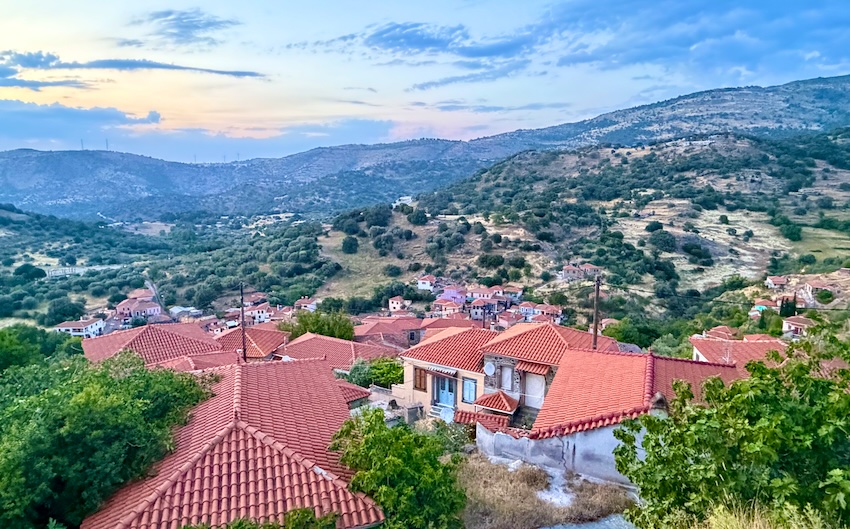
Vatousa, Lesvos
by Matt Barrett
For the last thirty plus years I have been visiting a small traditional village in western Lesvos every summer for a month or more. The reason is my sister-in-law, Pamela Jerome, who is an historical preservation architect well known for her work on the restoration of Frank Lloyd Wright’s Fallingwater, perhaps the most famous house in America after the White House. Pam bought an old house in Vatousa, restored it and another house nearby, and we have
been coming
ever since, having taken over the second house. With our daughter just having bought another house it seems likely we will either be living in or visiting Vatousa for the rest of our lives.
|
 |
|
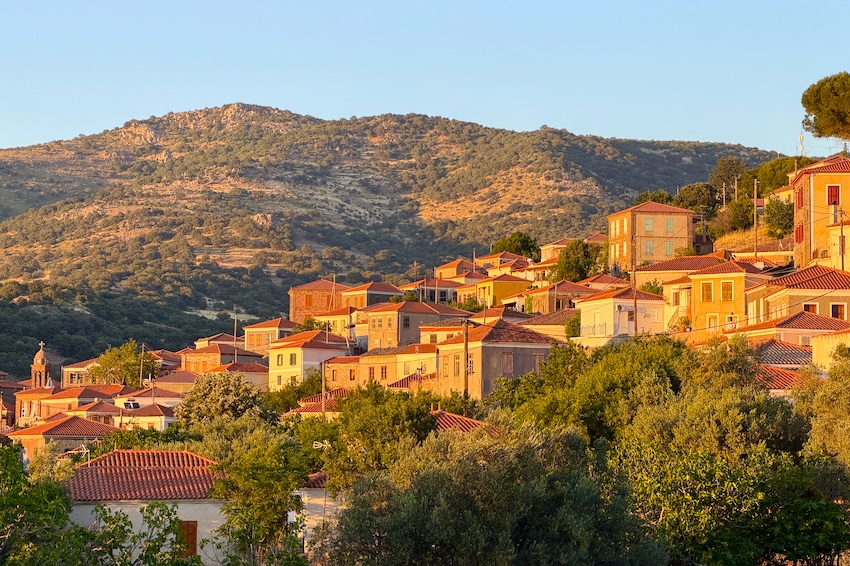
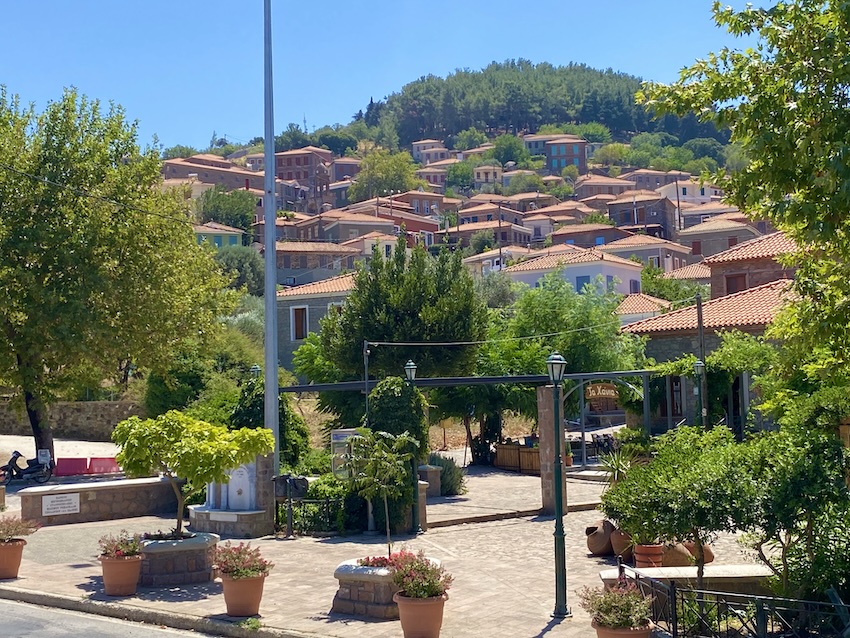
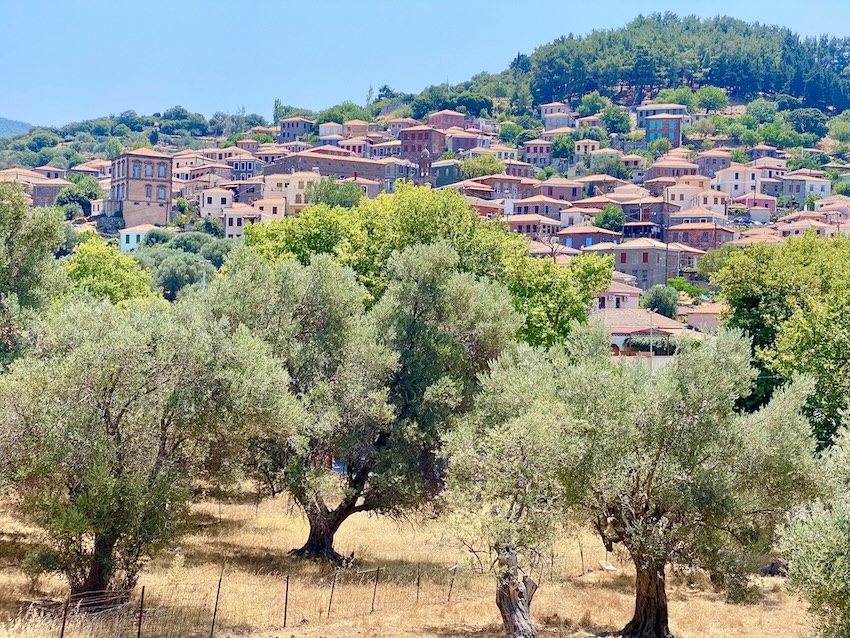
Vatousa sits within the caldera of a 22 million year old volcano, an area with mineral rich soil and very green by Greek Island standards. There are vinyards and a couple wineries nearby but most of the men have sheep and provide the nearby cheese factories with milk. Some of the best cheese in Greece comes from this area.
|
 |
|
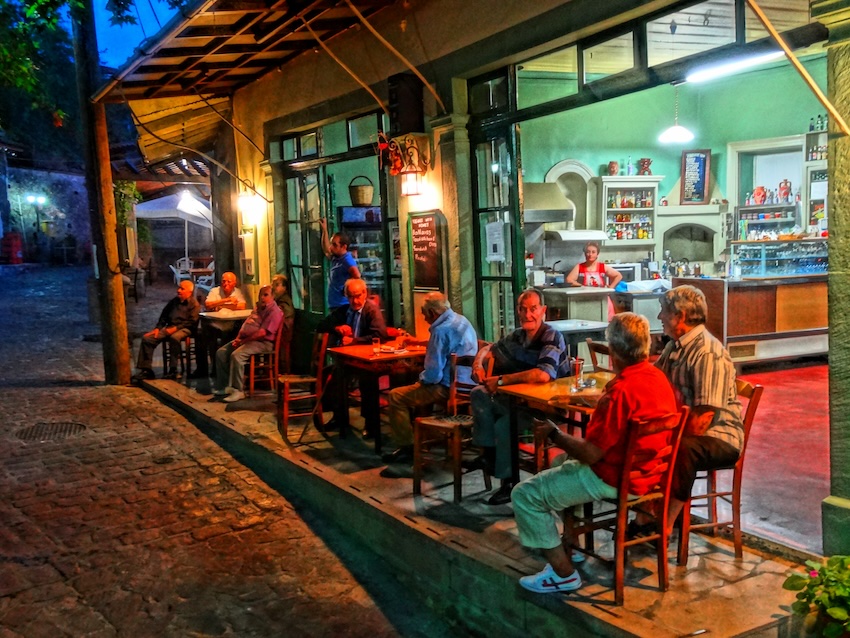
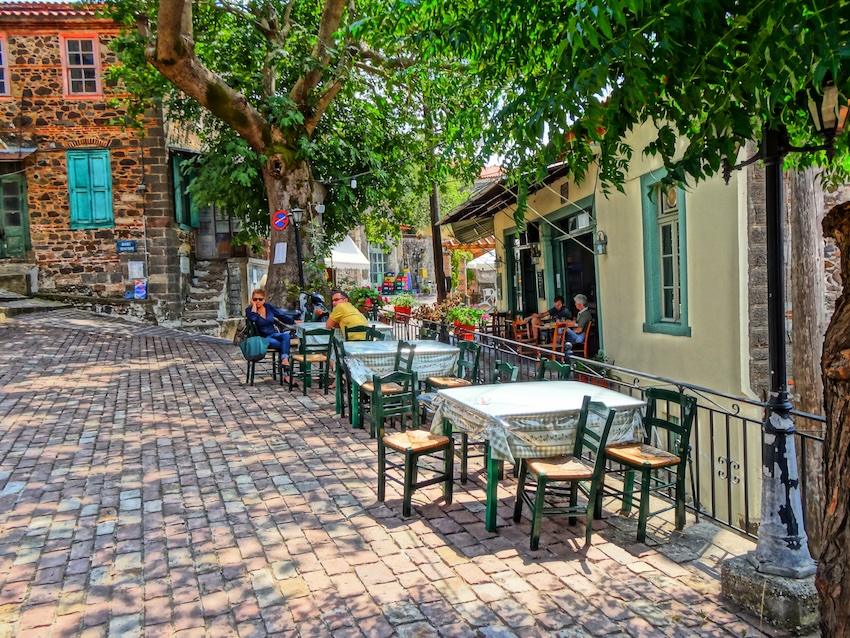
Life in the village revolves around several kafeneions. In the upper village in the town square there are three known by the names of their owners, Giannis, Michalis and Vasso. The largest of the 3 is owned by Giannis but known as Kamviselli for the late Pabli Kamviselli, the former owner and mayor of Vatousa, as well as a resident of Astoria, New York. Among other things he brought water to the village
and renovated the upper platia,
bringing back the cobblestone streets, and is something of a local hero. But actually most people call it the big kafeneion. Giannis and his wife and daughters serve simple but delicious mezedes and meals as well as ouzo, coffee, beer and your usual kafeneion fare. This kafeneion is one of the best examples of the typical Lesvos style kafeneions which have disappeared from the tourist towns but still exist in the traditional villages and the cities. In the summer when the village fills up with people returning
from Athens or abroad, they put tables in the square and it becomes what you might call a taverna. But much of the year it is a traditional kafeneion with really good food and atmosphere that caters to the local men and an occasional woman or two.
|
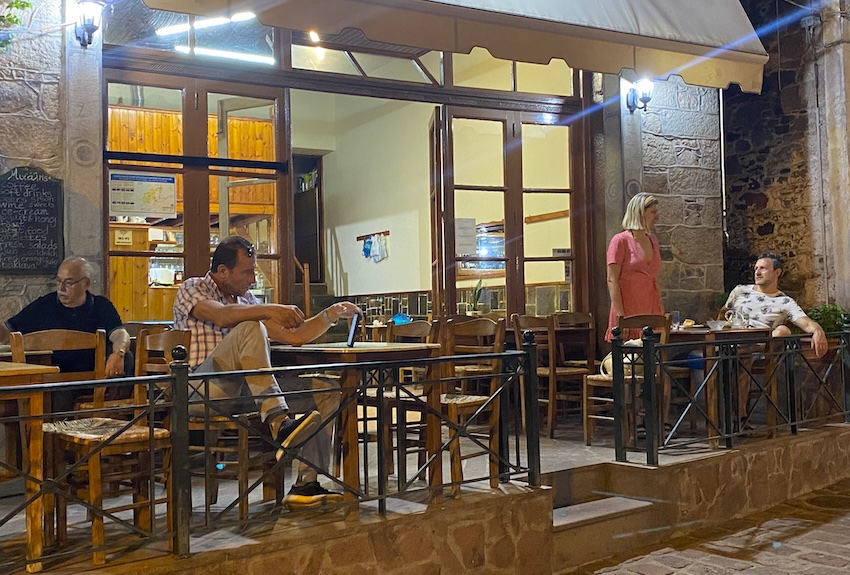 |
| Across and down the street is Cafe Koutroulis, or what we call Michali's which he opened with his father when I fist came to the village and now runs it with his wife and daughters. They also have delicious mezedes and whatever you want to drink with them. In the summer the space across the street is filled with tables and chairs and if there is an important game on he has a large screen TV. Mostly he plays laika and rembetika
music as they all do. The food is similar to the other kafeneions however Michalis used to have a souvlaki shop and now he serves souvlaki me pita, and kalamaki, from the kitchen of the kafeneion. |
 |
|
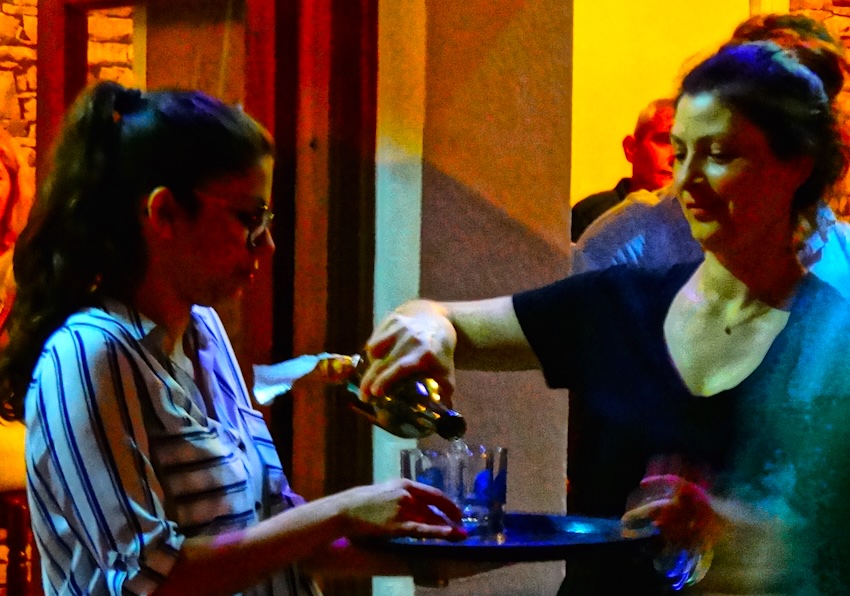
Across the street is what is currently being called The Kafeteria which was owned and run by the beautiful Vasso and her equally beautiful daughters. It started as a zacharoplasteion (sweet shop) serving pastries and traditional Greek desserts, but is now also a kafeneion/restaurant like the others. Vasso is only there in the summer because in the winter she has a very popular taverna called To Kadro, located just outside of the town of Kaloni, one of the best traditional restaurants on Lesvos. But in the summer there are lots of tables and chairs and sometimes live music and dancing in the street in front of the kafeneion. And while some people who live or visit the village regularly may have their favorite kafeneion in the village, where you choose to eat often depends on who happens to be sitting at one of the kafeneions and whether you want to talk to them or avoid them
|
 |
|
In the lower village on what used to be the main road from Mytilini to Eressos and Sigri is another platia and there are two more Kafeneions, Rena’s which is actually the name of the kafeneion and the name of the owner, and Ta Hania which is the name of the area. A hani is like an inn for travelers and the old hani is still there, having been restored, never reopened and now for sale. The kafeneion, Ta Hania, is a bonafide taverna but it is also kafeneion and a sort of snack bar. Owned by
popular bouzouki player and singer Yannis Karatsas, Ta Hania has a large shaded garden area with tables and chairs, and live music on Saturday nights and Sunday afternoons and people come from all over the island to eat and drink here. Both Ta Hania and Rena’s serve mezedes and grilled paidaikia, provatina and rotisserie chicken, lamb, pork and everything you would find in a psistaria.
|
|
Tryfon
|
|
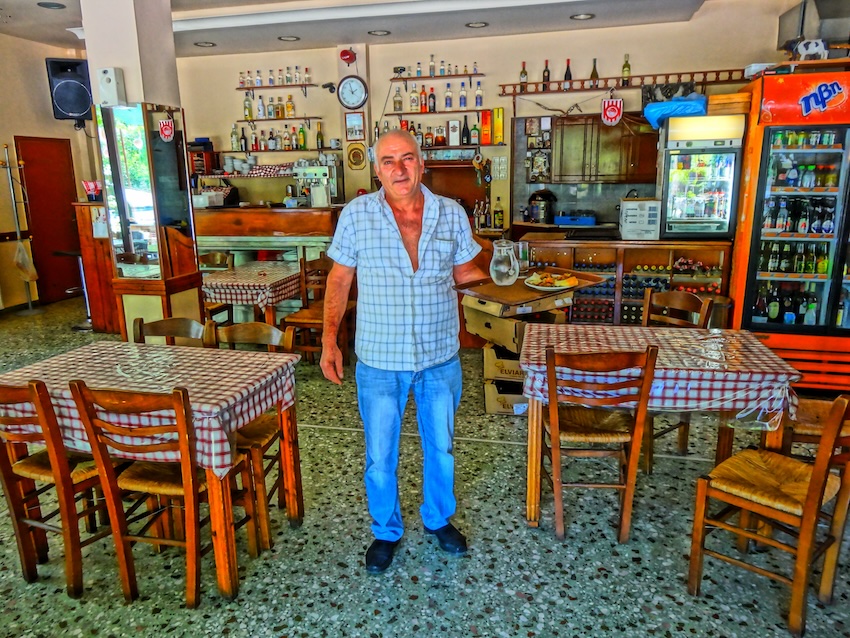
Rena's is the kafeneion we have the longest history with and is probably my favorite of them all though it's hard to say because each kafeneion is special in its own way. But when we first came to Vatousa in the last century, our favorite place was Tryfon's which was in the upper village in the big kafeneion where Giannis' is now. Tryfon served, Rena cooked, and our 5 year old daughter Amarandi ran around playing with their son Josiff who was the same age.
But the most serious person was Giorgos who was waiting tables at the age of 7 or maybe younger and remarkably efficient. We probably ate at Tryfon's more than any restaurant in Greece. But in Vatousa in the winter where having a successful kafeneion or going out of business can be the difference of one or two less coffees sold per day, Tryfon and family were forced to give up the big kafeneion and not even our summer eating habits could save it. After working for his brother-in-law Michalis for
a few years they opened Rena's. Tryfon passed away in the spring of 2026. Giorgos runs the restaurant as he has for at least the last 10 years, with his mother in the kitchen and a cousin or two helping serve. They have excellent mezedes and grilled meat all day which is good because they are not open at night. Giorgos married a girl from Skoutari and has to leave early to feed the sheep. But if any person was ever born to be a kafeneion owner it is Giorgos and it is always a pleasure to go there even if it means having my night out at one in the
afternoon.
|
|
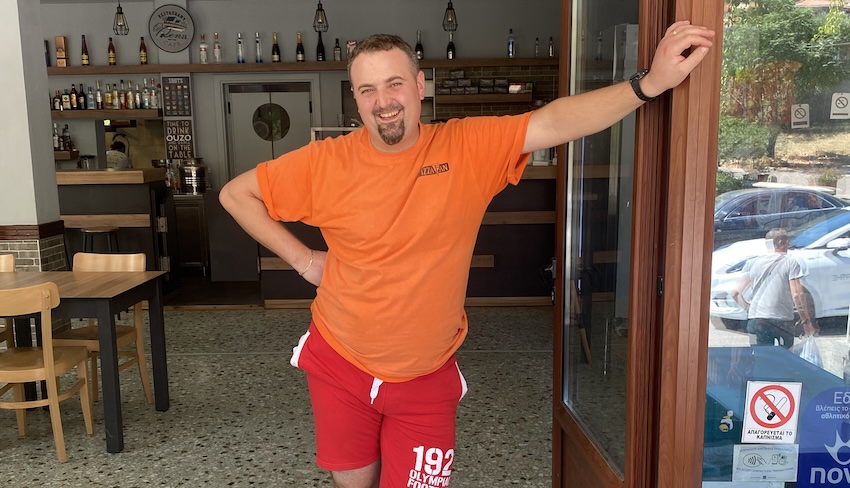
Giorgos Kalogerelis at Rena's
|
|
I should probably add that almost everything they serve at these kafeneions, restaurants or whatever you want to call them, is local, much of it produced or grown by the owner of the establishment be it feta cheese, yogurt, vegetables, lamb, chicken, pork, olive oil (extra virgin of course) olives and more. Giorgos is not the only kafeneion owner who is a shepherd. Most of them are or if not somebody in the family is.
|
 |
|
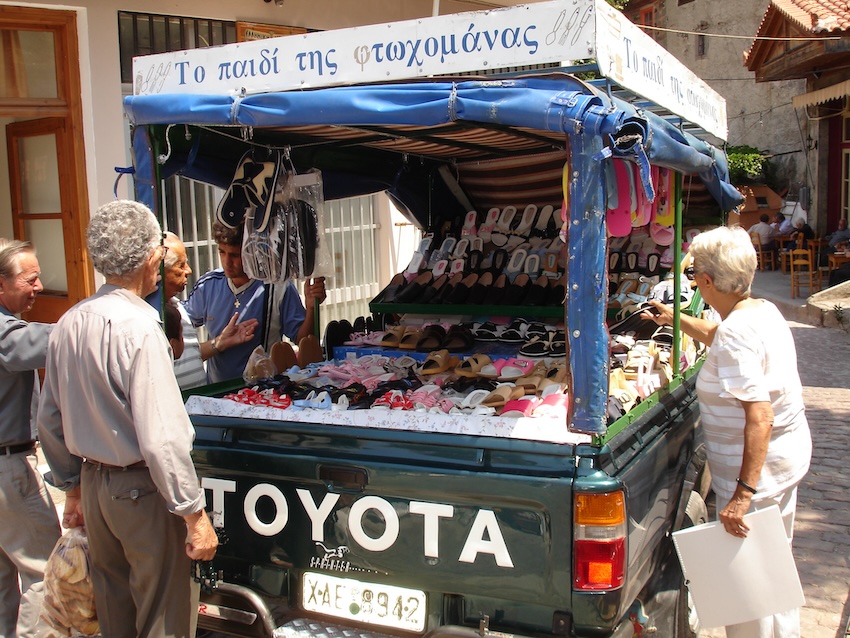
There are not many shops in Vatousa but you can buy all sorts of local traditional products and staples at Manolis’ Pandapoleion including home made traditional sweets, local ouzo, cheeses, olive oil and the amazing sheep’s milk ice cream from Mesotopos. For other essentials you can do what many of the locals do and sit in one of the kafeneions and listen for the sound of the loudspeaker announcing the arrival in the village of a truck selling fresh fruit,
vegetables, fish, kitchen utensils, chairs, shoes and even clothes. No need to go to the store when the store comes to you.
|
|
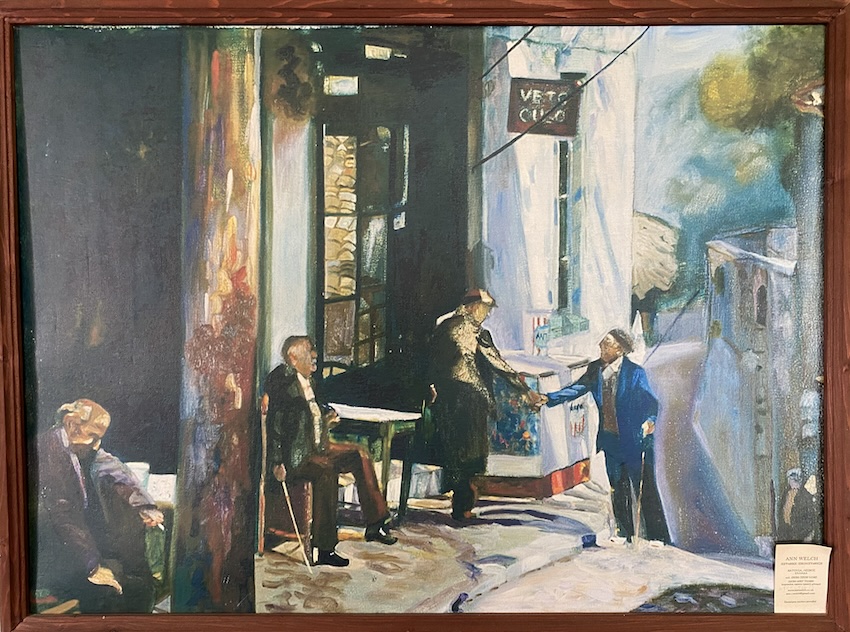
Kambeselis Kafeneion by Ann Welch
|
|
Like almost all the villages in Lesvos and much of Greece, Vatousa is losing population as old people die and young people go to the cities for work or university. There are dozens of houses for sale, some needing a lot of work, some needing little work at all and most falling somewhere in between. There is some effort by local artists to attract other creative people to the village and in fact there has always been a small artistic community
which included opera singer Joanna Sfekas-Karvelas, the painters Anne Welsh, Tracie Peisley and Fotis Karvelas, and celebrated artist and author Panagiotis Malamelis. The hope is that an influx of artists, musicians, poets, and digital nomads can inject life into the village by restoring some of the houses that seem forgotten by those who have outgrown village life or never had the opportunity to experience it.
|
|
|
|
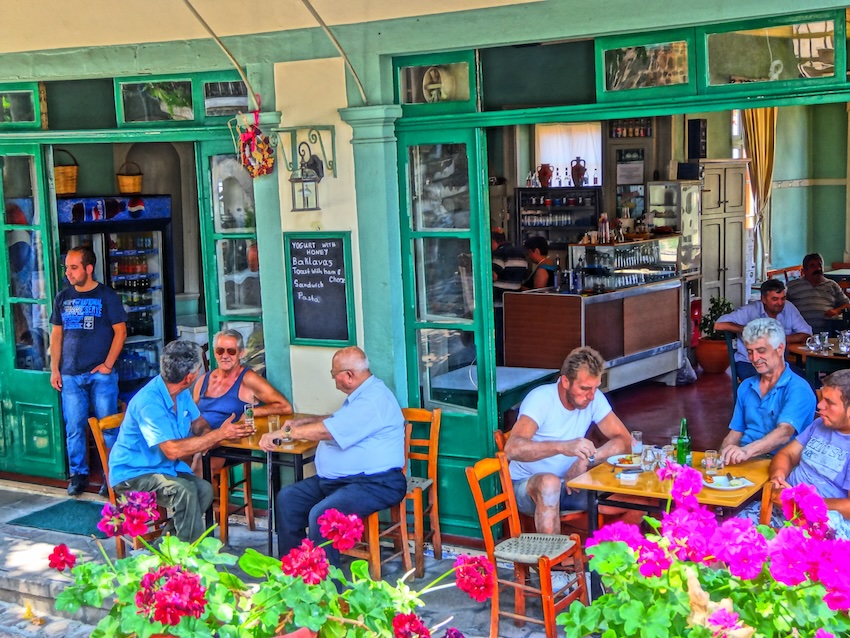
Not to give the impression that Vatousa is a dead or dying village. Between Easter and the end of September the kafeneions are full of villagers, retirees who live in Athens or abroad and come back for the warm months, and people from other villages who stop in for a change of scenery or at least a different menu. And from mid July until the end of August Vatousa is full as everyone who has a connection to the village comes back with their families and often
bringing friends along to experience what it’s like to live in a small mountain village in Lesvos. It can get so busy that some nights you need a reservation to sit at a table in the platia outside of Giannis’ kafeneion, and teenagers are waiting in line outside Michalis’ kafeneion which takes on extra duty as the local souvlaki shop.
|
 |
|
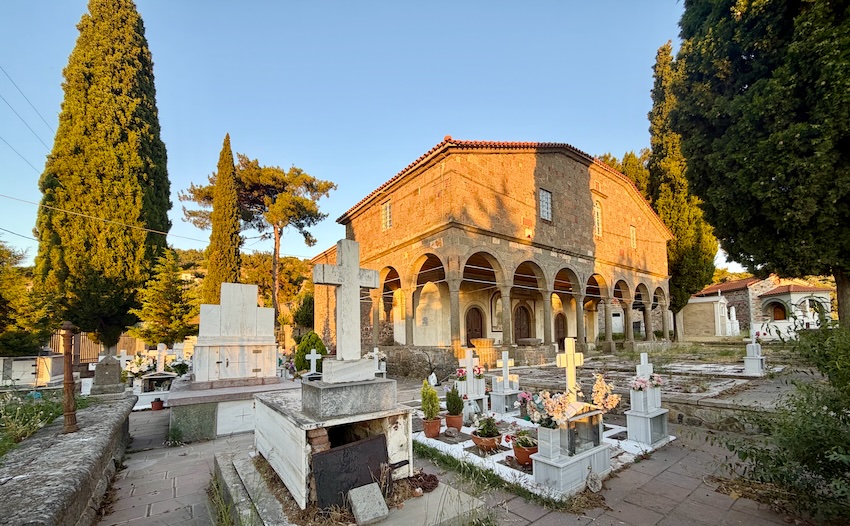
Vatousa has two 19th century churches, more like cathedrals, that are pretty spectacular by Greek village standards. The older of the two, The Church of the Archangels, dates from 1832 and is a three-aisled basilica, a construction reminiscent of the Patriarchate of Constantinople, and common to the Eastern Aegean. The interior of the church is decorated with folk art. The church itself is located in the village cemetery which has unusual vaulted tombs
still in use. In a corner of the cemetery are two buildings, one old and the other new, where wooden boxes contain the remains of the village deceased.
|
 |
|
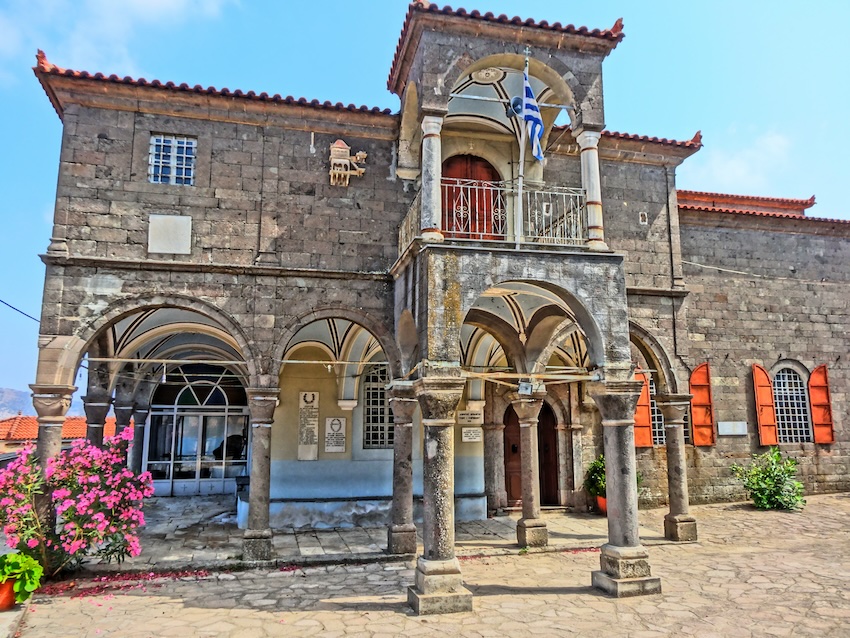
The more recent church, The Central Church of the Dormition of the Virgin, was built in 1850 of hand hewn stone and is of the
same style. The iconostasis of carved wood contains fine examples of post-Byzantine iconography. Also noteworthy in the platia is the bell tower which can give you a vantage point of the entire lower village and the valley, hills and mountains beyond. Depending upon when you look at it, this clock tells the correct time and its bell strikes loud and dramatically on the hour and half hour or close enough. You will also notice the small cathedral for the more spiritual birds of the village built on the wall of the church.
|
|
|
|
There is also a museum in the Gogos Mansion (large building on the left) whose nineteenth century neoclassical style matches many of the Mytilini mansions of the same period. In fact there are a number of old mansions around the village, some inhabited and others for sale for prices far lower than the price of simple village houses on the more popular islands.
|
|
Gavatha Beach
|
|
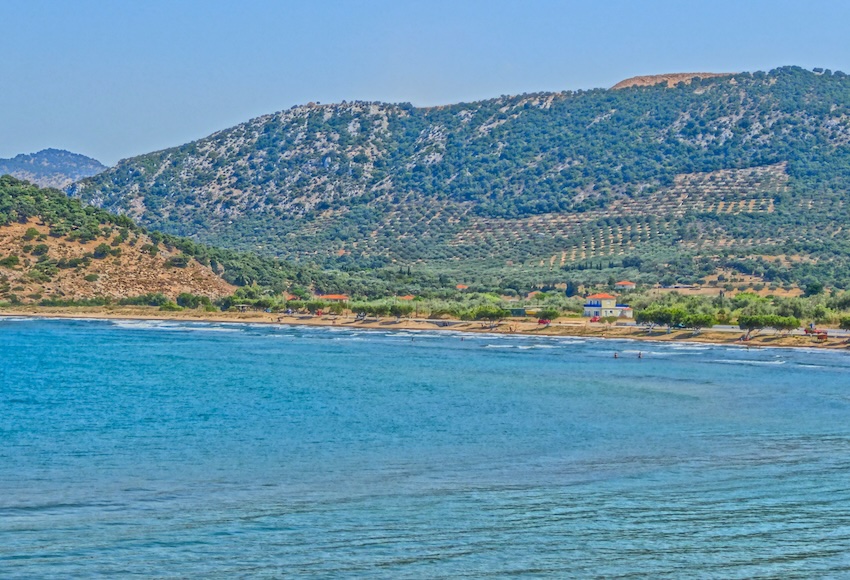
Though mountain villages by nature do not have beaches there are a number of beaches between 12 minutes to a half hour’s drive from Vatousa including Gavatha, Kampo Antissa, Kalo Limani, Agia Barbara, Lapsarna, Faneromeni, Sigri and Skala Eressos. (See Lesvos Beaches) With the completion of the highway from Kaloni to Sigri most of western Lesvos is within easy reach of Vatousa. Skalohori used to be a 20 minute drive and now we can leave our house and be sitting in Platanos Taverna
in about 10 minutes. Sigri which we used to visit for a swim and lunch at Kavo Doro only on special occasions is now a 22 minute drive. The beautiful platia of Antissa and the wonderful To Kati Allo Taverna takes about 10 minutes.
|
|
Vathilimno Waterfall
|
|
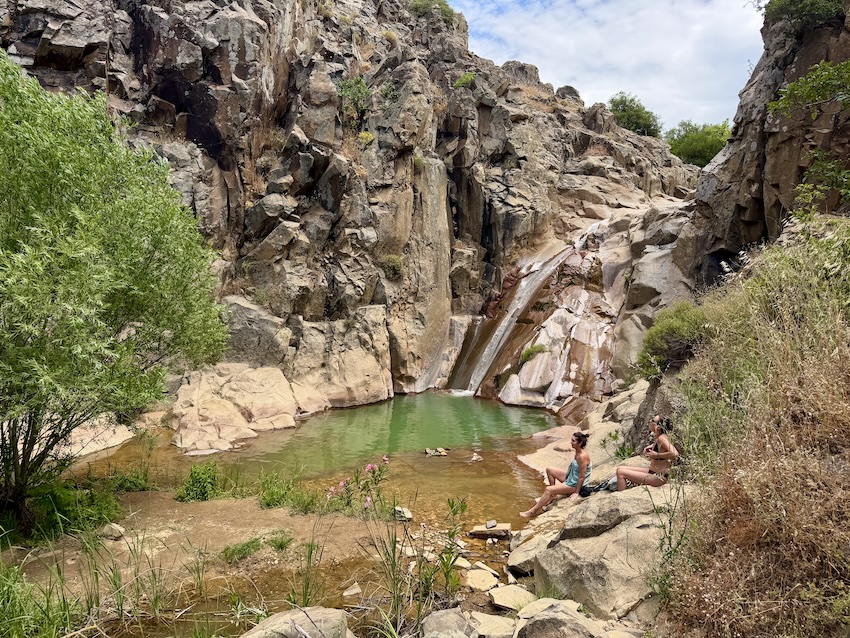
With walking trails that pass through Vatousa and go all over the island through olive groves, farms, oak forests, past waterfalls and streams, valleys, hills and mountains to even more remote villages like Pterounda, Rema, Hidira, Zithra and Liota, hikers and runners can always find somewhere new to visit within striking distance on foot.
|
 |
|
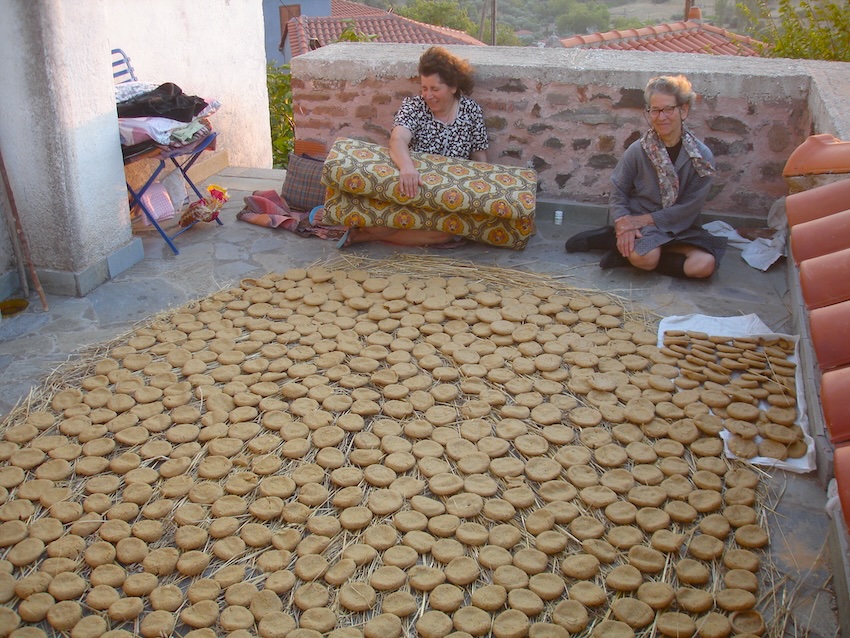
During the summer the people of Vatousa make their winter supply of Trahana. This is a staple of many of the villages, made with wheat and fermented sheep milk which is mixed together and then formed into cups, called xaxles or koupes and then dried. Because it takes several days to dry, and they make alot of it, the villagers take turns guarding it from the neighborhood cats who love it and try to steal it. Once it is dried it can be stored and eaten later crumbled into soup or even on its own. Some people like it and others don’t care for it but it has a unique taste. In July Vatousa has a Trahana Festival with exhibits, food and music and of course lots of trahana.
|
 |
|
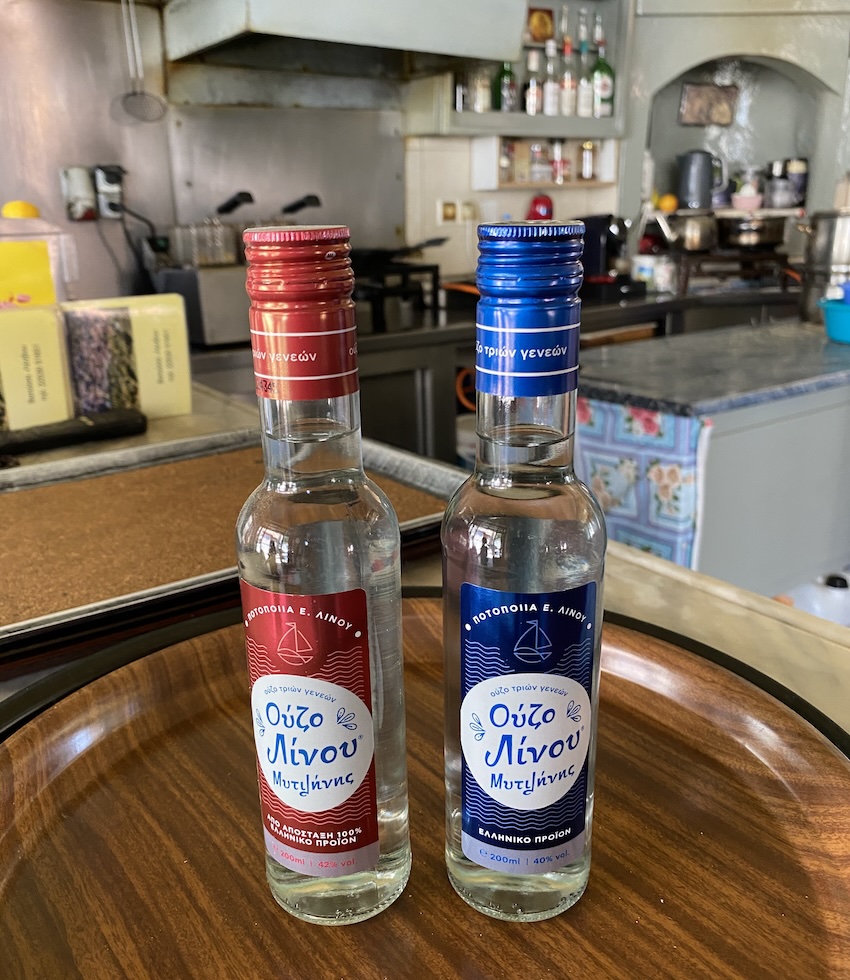
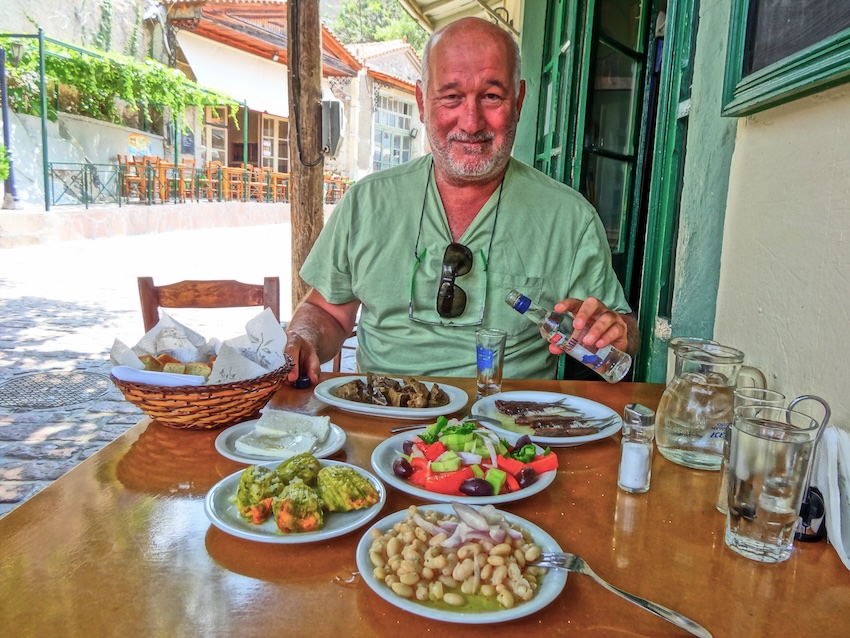
Like all villages in Lesvos most of the men drink ouzo. They drink other things as well but mainly ouzo. In Vatousa and Hidira and some of the other villages the ouzo of choice is Linou, usually the blue bottle. I drink the Linou Red because it’s distilled but some kafeneions don’t carry it because everyone drinks the blue. Sometimes I will sit down at a kafeneion in another part of the island and they automatically bring me a bottle of Linou Blue and I ask why they brought this particular ouzo and they say it’s because I live in Vatousa (or Hidira) and everyone knows that’s what they drink there. I say ok but bring me the red please.
So why of all the ouzos on Lesvos do the people of Vatousa and Hidira drink Linou? It’s because in past years they all drank Ouzo Kefi. When the owner of the company retired or died his two sons split the business and so to be fair they retired the name Kefi and one son created Linou and the other Ouzo Lesbion. Why everyone decided on Linou I have no idea. They are both good. And even though the kafeneions all serve Linou, in Manolis’ store he sells Lesbion. Why? I don’t know. It’s just one of life’s mysteries.
|
|
|
|
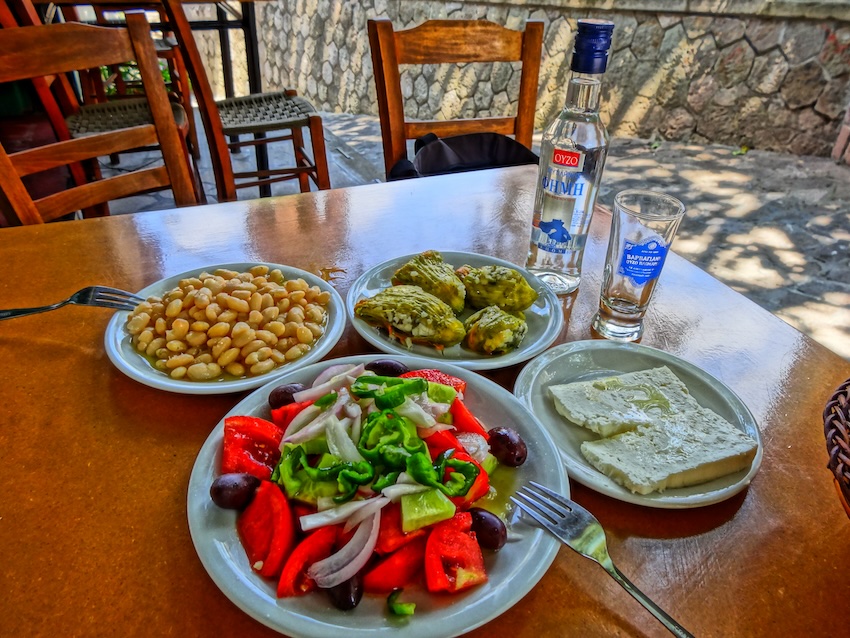
When you order a bottle of ouzo in one of the kafeneions it comes with several small plates of food, usually whatever they happen to be serving with their ouzo that day. They will ask you if you want the ouzo with meze (you do) and it’s included in the price of the bottle. If you want something in particular you can ask for it but you have to pay per dish like a normal restaurant. People also order ouzo by the glass and then you may have to ask for meze. I don’t actually know because I never order ouzo by the glass. But if you go to Rena’s for an ouzo and ask for it by the glass he gives you a little tiny bottle that is actually more than a glass (unless you drink it straight which you shouldn’t.) I asked Giorgos why he got these little bottles and he said because he got tired of having to come out of the kitchen to pour glasses of ouzo every 5 minutes. Now if he’s busy they can just go to the counter and take one and Giorgos can count up the empty bottles at the end.
|
|
|
|
So if you are looking for something totally different in Lesvos stop in for a visit, a coffee, an ouzo and simple meze, a meal, or a Saturday night or Sunday afternoon of rembetika and laika music at Ta Hania. If you follow the sign towards Hidira and the Digital Art Museum of Giorgos Iakovidis you can park by the old church and the school and walk to the platia without having to climb a mountain. And if you are looking for a change of lifestyle, living
in a mountain village on Lesvos may keep you alive longer than wherever you are living now. Maybe I will see you there.
|
|
Matt Barrett, Vatousa, Lesvos
|
|
Be sure to visit my Original Vatousa Website which I made sometime around 1996 for more information about the village and the people.
If you are interested in buying a house in Vatousa contact Ioanna Kritikou. Her email is ionkriti@gmail.com and her mobile is (30)698 1790375
|
|