Ouzo: Greece's Most Popular Drink
|
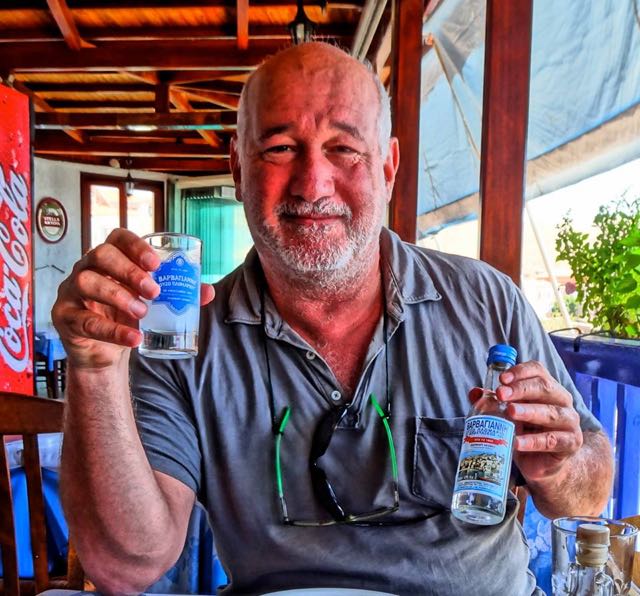 Ouzo drinking is an art. Or maybe it's a way of life. Whatever it is, Greece, and in particular the island of Lesvos, is known for it's
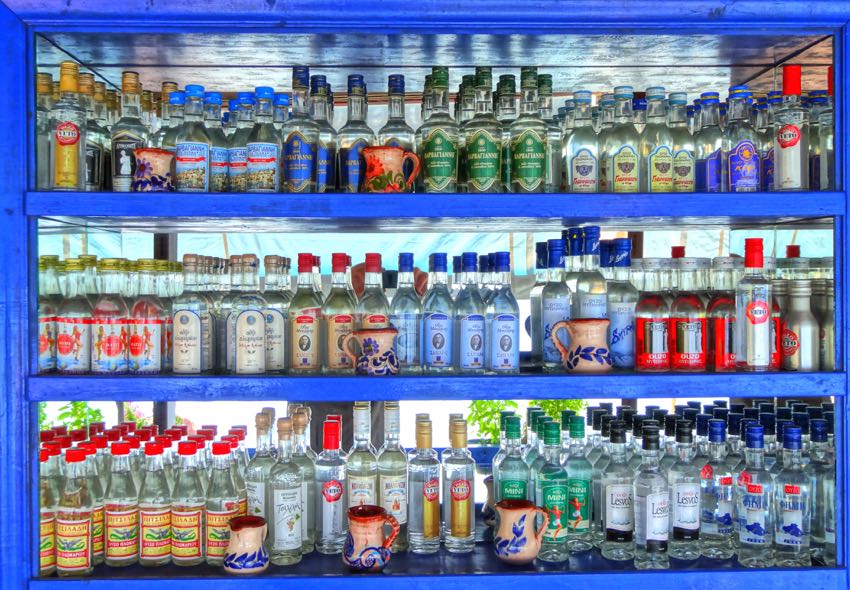
ouzo. Most cafe owners in Greece will admit that the best ouzo comes from Lesvos, also known as Mytilini, and they probably carry one of the
more popular commercial brands like Mini or Plomari. But it's not just the ouzo, it's who you drink it with that really makes the experience.
When I am in Lesvos I spend a lot of time drinking ouzo, talking and eating with my friends. So much so, that when it is
time to return to America I have to seriously consider becoming a member of Alcoholics Anonymous. But usually my desire for ouzo
ends when I get on the plane back to America and the two or three bottles I bring back with me every trip begin to add up so there is room for nothing else in my liquor cabinet and then I have to start drinking ouzo again or giving them away as Christmas gifts and birthday presents. Its an endless cycle that has made me a favorite with friends and family members, not to mention cafe owners and ouzo shops. Ouzo drinking is an art. Or maybe it's a way of life. Whatever it is, Greece, and in particular the island of Lesvos, is known for it's
ouzo. Most cafe owners in Greece will admit that the best ouzo comes from Lesvos, also known as Mytilini, and they probably carry one of the
more popular commercial brands like Mini or Plomari. But it's not just the ouzo, it's who you drink it with that really makes the experience.
When I am in Lesvos I spend a lot of time drinking ouzo, talking and eating with my friends. So much so, that when it is
time to return to America I have to seriously consider becoming a member of Alcoholics Anonymous. But usually my desire for ouzo
ends when I get on the plane back to America and the two or three bottles I bring back with me every trip begin to add up so there is room for nothing else in my liquor cabinet and then I have to start drinking ouzo again or giving them away as Christmas gifts and birthday presents. Its an endless cycle that has made me a favorite with friends and family members, not to mention cafe owners and ouzo shops.
|
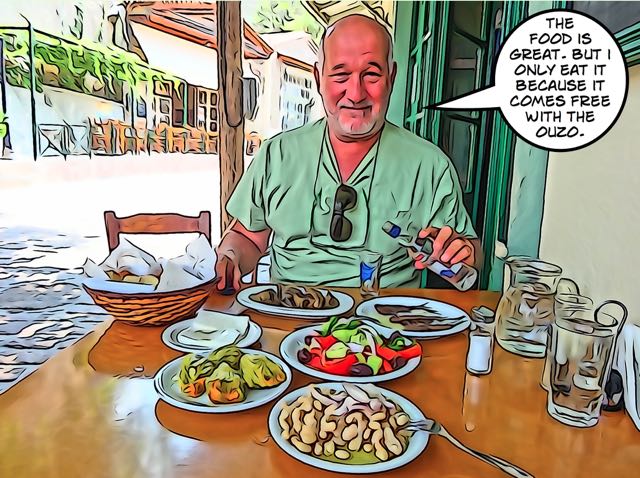 The key to drinking ouzo is to eat snacks known as mezedes or meze. These keep the effects of the alcohol
from overwhelming you and enable you to sit and drink slowly for hours in a profoundly calm state of mind where
all is beautiful and life is fine. In the villages on the Greek islands and the mainland where life is slow, ouzo is partaken day or night. On Sundays
after church the cafeneons are full of lively voices and singing, including sometimes the village priest. In many
cafeneons the cooking is done by men, but in some it is a woman who does the cooking and serving and acts as den
mother to the old men who come around each day. She knows their likes and dislikes, favorite seats and personal
history. But ouzo is not only found in rural Greece. It is still one of the most popular methods of alcohol intake in the towns and cities and there are restaurants known as ouzeries and mezedopoulions which specialize in ouzo and the foods that go with them. The key to drinking ouzo is to eat snacks known as mezedes or meze. These keep the effects of the alcohol
from overwhelming you and enable you to sit and drink slowly for hours in a profoundly calm state of mind where
all is beautiful and life is fine. In the villages on the Greek islands and the mainland where life is slow, ouzo is partaken day or night. On Sundays
after church the cafeneons are full of lively voices and singing, including sometimes the village priest. In many
cafeneons the cooking is done by men, but in some it is a woman who does the cooking and serving and acts as den
mother to the old men who come around each day. She knows their likes and dislikes, favorite seats and personal
history. But ouzo is not only found in rural Greece. It is still one of the most popular methods of alcohol intake in the towns and cities and there are restaurants known as ouzeries and mezedopoulions which specialize in ouzo and the foods that go with them. |
Matt's Favorite Ouzo
|
 |
|
|
|
Shop for Ouzo at Greece and Grapes
|
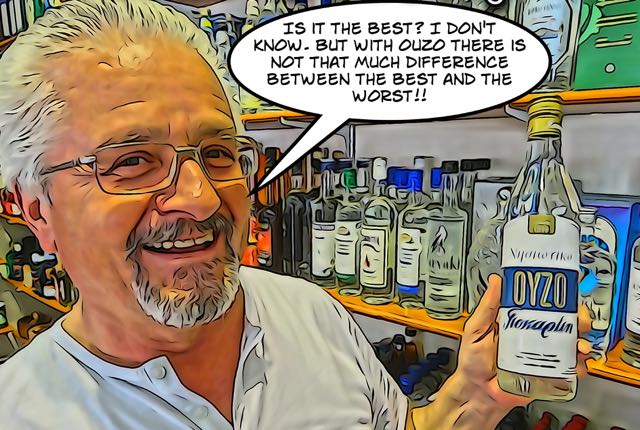 In the same way that the best tequila is 100% pure agave, the best ouzo in my opinion is 100% apostegmeno, which means distilled. Just look on the bottle for the 100% that is what you want. There are many other smaller companies in Lesvos like Kronos, Mattis, Samara, Thymi, Smyrna all of which are
excellent.
Next door on the island of Chios where they are more known for Masticha, a spirit made from the sap of the masticha tree, they also make some nice ouzos like Kazanisto, Kakitsi and Apalarina. In Samos they make a nice ouzo called Giokarinis. Then there are the commercial ouzos made for tourists and Greek-Americans who don't know
good ouzo from sambucca and are generally too sweet or in some cases just plain undrinkable. I don't want to
name them because they are big corporations with an image to preserve and employ a multitude of lawyers to help
them preserve it but if you stick with the ouzos I mention above you should be OK. If you need help you can go to Angelo the Ouzo King at 120 Adrianou Street in the Plaka of Athens. In the same way that the best tequila is 100% pure agave, the best ouzo in my opinion is 100% apostegmeno, which means distilled. Just look on the bottle for the 100% that is what you want. There are many other smaller companies in Lesvos like Kronos, Mattis, Samara, Thymi, Smyrna all of which are
excellent.
Next door on the island of Chios where they are more known for Masticha, a spirit made from the sap of the masticha tree, they also make some nice ouzos like Kazanisto, Kakitsi and Apalarina. In Samos they make a nice ouzo called Giokarinis. Then there are the commercial ouzos made for tourists and Greek-Americans who don't know
good ouzo from sambucca and are generally too sweet or in some cases just plain undrinkable. I don't want to
name them because they are big corporations with an image to preserve and employ a multitude of lawyers to help
them preserve it but if you stick with the ouzos I mention above you should be OK. If you need help you can go to Angelo the Ouzo King at 120 Adrianou Street in the Plaka of Athens.
WARNING! If you don't like licorice you probably won't like Ouzo
|
|
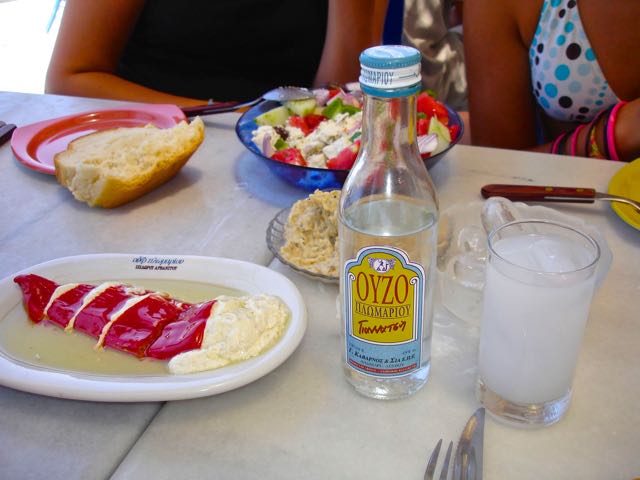 Some of the more popular brands of the ouzos on Lesvos are not 100% apostegmeno (distilled). In other words they just buy the ingredients and assemble them in the shops and then bottle it and sell. But lately these companies have been putting out two types of ouzo, one distilled and one not
as people begin to understand that distilled ouzo is better. In Plomari the Ouzo Giannatsi which
was founded by Greek-Australian George Kabarnos and his son, is distilled in the old fashioned way and is one of the
best tasting ouzos I have tried. Because they were a small company and not able to pay the large sums of money required
to get a product placed in supermarkets, their ouzo could be found only in his shop in Plomari and in some small
cafeneons and restaurants in the area. However the company was sold and now you can find Gianatsi even in Athens and some of the other islands. According to Mr. Kabarnos real traditional distilled ouzo has no side effects
(besides drunkeness) and will not cause a hangover because there is no sugar added and the other ingredients which
give each ouzo its distinct flavor, is cooked rather then just added to the mixture. To test this claim I brought
a bottle of Giannatsi to my friend Michalis, the owner of the cafeneon in the upper village of Vatousa and asked
him to try it. He was quite impressed and then pointed to the bottle where the word Apostegmena was written. "You see this Mathios? This is why this
ouzo is so good. It is distilled." Some of the more popular brands of the ouzos on Lesvos are not 100% apostegmeno (distilled). In other words they just buy the ingredients and assemble them in the shops and then bottle it and sell. But lately these companies have been putting out two types of ouzo, one distilled and one not
as people begin to understand that distilled ouzo is better. In Plomari the Ouzo Giannatsi which
was founded by Greek-Australian George Kabarnos and his son, is distilled in the old fashioned way and is one of the
best tasting ouzos I have tried. Because they were a small company and not able to pay the large sums of money required
to get a product placed in supermarkets, their ouzo could be found only in his shop in Plomari and in some small
cafeneons and restaurants in the area. However the company was sold and now you can find Gianatsi even in Athens and some of the other islands. According to Mr. Kabarnos real traditional distilled ouzo has no side effects
(besides drunkeness) and will not cause a hangover because there is no sugar added and the other ingredients which
give each ouzo its distinct flavor, is cooked rather then just added to the mixture. To test this claim I brought
a bottle of Giannatsi to my friend Michalis, the owner of the cafeneon in the upper village of Vatousa and asked
him to try it. He was quite impressed and then pointed to the bottle where the word Apostegmena was written. "You see this Mathios? This is why this
ouzo is so good. It is distilled."
|
|
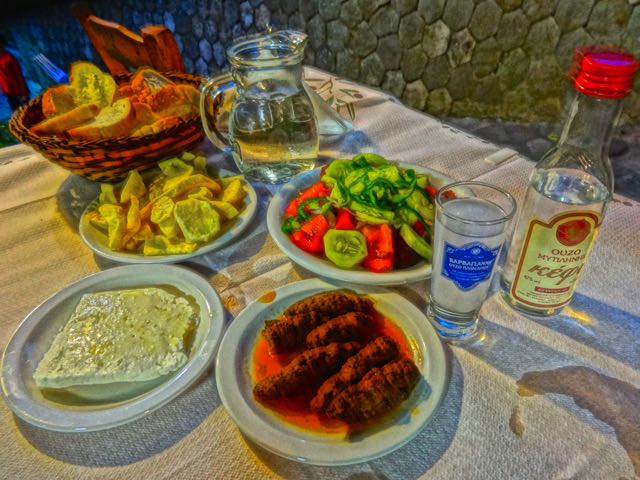 In the cafeneons in the traditional villages of Lesvos, ouzo is served with a meze included, for about a euro for a glass. Or you can save the waiter some running back and forth and order the small 200ml bottles. The mezedes can be anything
from a salad, stewed
meat and vegetables, sardeles
pastes, koukia (fava beans), sweetbreads, meatballs, cheese, sausage, fried fish or whatever
the specialty of that cafeneon is that day. Eat and drink slowly and enjoy the journey. The cafe owners are usually good cooks and in many places it is almost like a competition over who has the best mezedes. Just order an ouzo meh meze and see what they bring you. If you see someone at another table has something that looks interesting order that too. In an ouzeri or mezedopoulion you order the dishes individually or you can get a pikilia, which is a variety of things. I recommend you do that
if it is your first time. The best mezedes with ouzo are octopus, sardeles pastes, lakerda, smoked or pickled skoumbri and most things from the sea. See my Mezedes page In the cafeneons in the traditional villages of Lesvos, ouzo is served with a meze included, for about a euro for a glass. Or you can save the waiter some running back and forth and order the small 200ml bottles. The mezedes can be anything
from a salad, stewed
meat and vegetables, sardeles
pastes, koukia (fava beans), sweetbreads, meatballs, cheese, sausage, fried fish or whatever
the specialty of that cafeneon is that day. Eat and drink slowly and enjoy the journey. The cafe owners are usually good cooks and in many places it is almost like a competition over who has the best mezedes. Just order an ouzo meh meze and see what they bring you. If you see someone at another table has something that looks interesting order that too. In an ouzeri or mezedopoulion you order the dishes individually or you can get a pikilia, which is a variety of things. I recommend you do that
if it is your first time. The best mezedes with ouzo are octopus, sardeles pastes, lakerda, smoked or pickled skoumbri and most things from the sea. See my Mezedes page
|
|
 Don't be macho. Drink ouzo with water. When you pour it in the ouzo will turn a milky white. How much to pour in is a matter of taste. A good trick is to water it down as you drink it. In other words you keep adding water. You won't get as drunk this way and because
you will be drinking as much water as ouzo (or more) you won't be dehydrated or hungover (maybe). If you should be lucky (or unlucky) enough to meet someone who makes his own ouzo watch out. Though they call it ouzo it is
really raki or tsipuro and does not have that licorice flavor one associates with ouzo. It is made in homemade stills and
goes down smooth but it's effects are rapid and powerful. But one glass won't hurt and two is even better. As long as they are very small glasses. Kostas at the Blue Sardine in Skala Eressos, Lesvos, is known for his fish mezedes, choice of ouzo and his home made XX-rated tsipuro which he may bring out at the end of a meal if he thinks you can handle it. Don't be macho. Drink ouzo with water. When you pour it in the ouzo will turn a milky white. How much to pour in is a matter of taste. A good trick is to water it down as you drink it. In other words you keep adding water. You won't get as drunk this way and because
you will be drinking as much water as ouzo (or more) you won't be dehydrated or hungover (maybe). If you should be lucky (or unlucky) enough to meet someone who makes his own ouzo watch out. Though they call it ouzo it is
really raki or tsipuro and does not have that licorice flavor one associates with ouzo. It is made in homemade stills and
goes down smooth but it's effects are rapid and powerful. But one glass won't hurt and two is even better. As long as they are very small glasses. Kostas at the Blue Sardine in Skala Eressos, Lesvos, is known for his fish mezedes, choice of ouzo and his home made XX-rated tsipuro which he may bring out at the end of a meal if he thinks you can handle it.
|
|
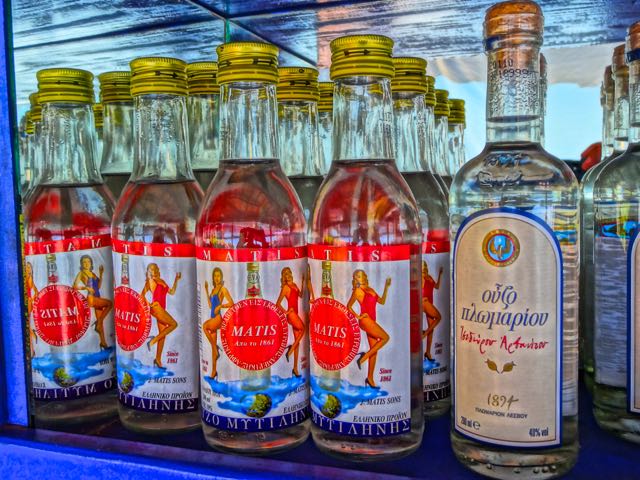 The seaside town of Plomari in Lesvos is most known for its ouzo. It is where Ouzo Barbagiannis, Ouzo Giannatsi and now perhaps the most famous: Ouzo Plomari of Isidorou Arvanitou, the first ouzo
with the cork in it and one of the best tasting and the best selling ouzo in Greece. Strangely enough I could
not find it in the cafeneons the first time I went to Plomari. The story I was told is that the owner of Ouzo 12, one of the most popular of the Greek ouzo companies, was bought out by the giant Seagrams company. He took his money and bought the small Arvanitis distillery in Plomari and changed the recipe and made it a kinder-gentler
ouzo so people like me would like it and they could hopefully market it all over Greece and maybe in America too.
But in Plomari they still like the original recipe so there are actually two versions. The bottle in Plomari is
completely different and it does not have a cork and it is stronger. I went to the factory to check out the authenticity
of this story and unfortunately it was closed. Since then they have used their marketing expertise to make the
ouzo with the cork one of the most popular in Greece. You can get it at duty-free in the airport and maybe even at your favorite liquor store at home. The attractiveness
of the bottles has made them very popular in restaurants which use them for oil and vinegar on the tables. To make the story even more interesting Ouzo 12 sales plummeted after the purchase and he was able to buy back the company with all the money he made from Ouzo Plomari. Then he changed the bottle, added a cork, and did a similar marketing campaign and now he has two of the three most popular ouzos in Greece. (The third is Mini). The seaside town of Plomari in Lesvos is most known for its ouzo. It is where Ouzo Barbagiannis, Ouzo Giannatsi and now perhaps the most famous: Ouzo Plomari of Isidorou Arvanitou, the first ouzo
with the cork in it and one of the best tasting and the best selling ouzo in Greece. Strangely enough I could
not find it in the cafeneons the first time I went to Plomari. The story I was told is that the owner of Ouzo 12, one of the most popular of the Greek ouzo companies, was bought out by the giant Seagrams company. He took his money and bought the small Arvanitis distillery in Plomari and changed the recipe and made it a kinder-gentler
ouzo so people like me would like it and they could hopefully market it all over Greece and maybe in America too.
But in Plomari they still like the original recipe so there are actually two versions. The bottle in Plomari is
completely different and it does not have a cork and it is stronger. I went to the factory to check out the authenticity
of this story and unfortunately it was closed. Since then they have used their marketing expertise to make the
ouzo with the cork one of the most popular in Greece. You can get it at duty-free in the airport and maybe even at your favorite liquor store at home. The attractiveness
of the bottles has made them very popular in restaurants which use them for oil and vinegar on the tables. To make the story even more interesting Ouzo 12 sales plummeted after the purchase and he was able to buy back the company with all the money he made from Ouzo Plomari. Then he changed the bottle, added a cork, and did a similar marketing campaign and now he has two of the three most popular ouzos in Greece. (The third is Mini).
|
|
Shop for Ouzo at Greece and Grapes
|
Ouzo Flashback
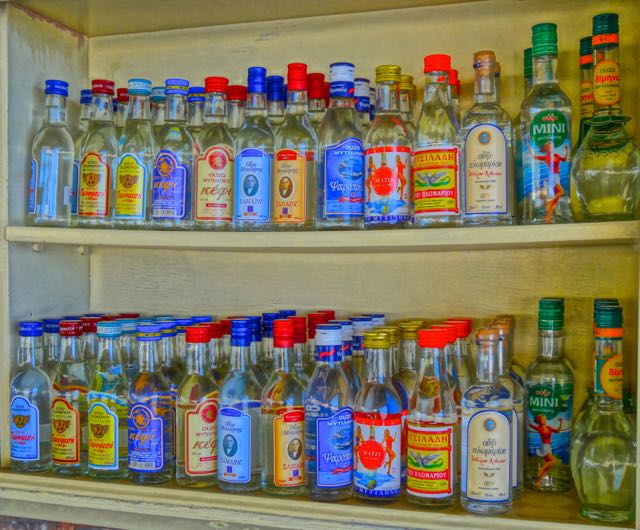 I can almost remember my first ouzo 'experience'. I was a sophomore in high school attending the American Community School in Athens. My friends and I were at a neighborhood cafeneon in Halandri, loosening up for the big dance
by drinking Ouzo 12, the popular Athenian brand. Though we had all sampled ouzo before this was the first time we
had come to a cafeneon with the intent of using it as our primary source of entertainment, (not counting the dance
itself.) Being young and not having the benefit of experience or articles like this one we were drinking it straight. At 7:30 I knew I had enough and began walking the quarter of a mile to the school gym. I arrived there
just as the buses were taking the kids home at 11:30. What happened to those four hours I will probably never know
though I have always suspected that I was picked up by aliens and experimented upon before having some kind of
chip implanted in me that made me unable to take school very seriously and rendered me useless for any kind of
job besides being a musician and giving unsolicited advice about Greece. The purpose of this and what the aliens
have in store for me I can only guess at. I can almost remember my first ouzo 'experience'. I was a sophomore in high school attending the American Community School in Athens. My friends and I were at a neighborhood cafeneon in Halandri, loosening up for the big dance
by drinking Ouzo 12, the popular Athenian brand. Though we had all sampled ouzo before this was the first time we
had come to a cafeneon with the intent of using it as our primary source of entertainment, (not counting the dance
itself.) Being young and not having the benefit of experience or articles like this one we were drinking it straight. At 7:30 I knew I had enough and began walking the quarter of a mile to the school gym. I arrived there
just as the buses were taking the kids home at 11:30. What happened to those four hours I will probably never know
though I have always suspected that I was picked up by aliens and experimented upon before having some kind of
chip implanted in me that made me unable to take school very seriously and rendered me useless for any kind of
job besides being a musician and giving unsolicited advice about Greece. The purpose of this and what the aliens
have in store for me I can only guess at. |
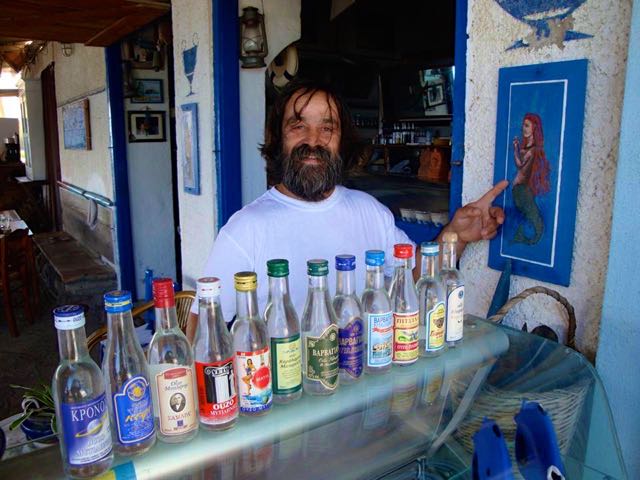
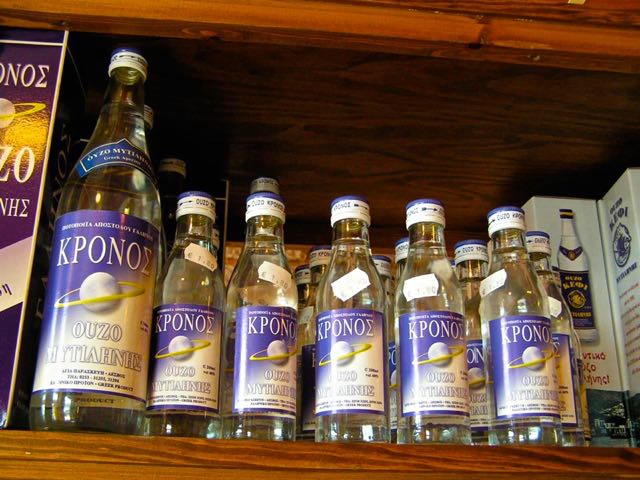 My big plan one summer was to fill a carton with as many different 200 ml bottles I could
find on the island. What I discovered is that there are a lot of brands of ouzo that I had never seen or heard
of before. Even the small town of Skalahori, with a population of about 500 people has its own ouzo factory. One of the
best of these small brands I discovered on a visit to the village of Agia Paraskevis. The ouzo there is called
Kronos and though the owner of the company (a shop really), seemed a little suspicious of my interest in ouzo,
he warmed up enough to give me a bottle which I took home to my village. It turned out to be Andrea's favorite
ouzo and I liked it too. As far
as I could tell the only people who worked for the company at all are Mr. Kronos and a very nice young guy who was happy to make the most of the opportunity to promote the company by giving me a tour of the factory which was really just one big room. A few weeks later it burned down. But they rebuilt it and now you can find Kronos all over. My big plan one summer was to fill a carton with as many different 200 ml bottles I could
find on the island. What I discovered is that there are a lot of brands of ouzo that I had never seen or heard
of before. Even the small town of Skalahori, with a population of about 500 people has its own ouzo factory. One of the
best of these small brands I discovered on a visit to the village of Agia Paraskevis. The ouzo there is called
Kronos and though the owner of the company (a shop really), seemed a little suspicious of my interest in ouzo,
he warmed up enough to give me a bottle which I took home to my village. It turned out to be Andrea's favorite
ouzo and I liked it too. As far
as I could tell the only people who worked for the company at all are Mr. Kronos and a very nice young guy who was happy to make the most of the opportunity to promote the company by giving me a tour of the factory which was really just one big room. A few weeks later it burned down. But they rebuilt it and now you can find Kronos all over. |
|
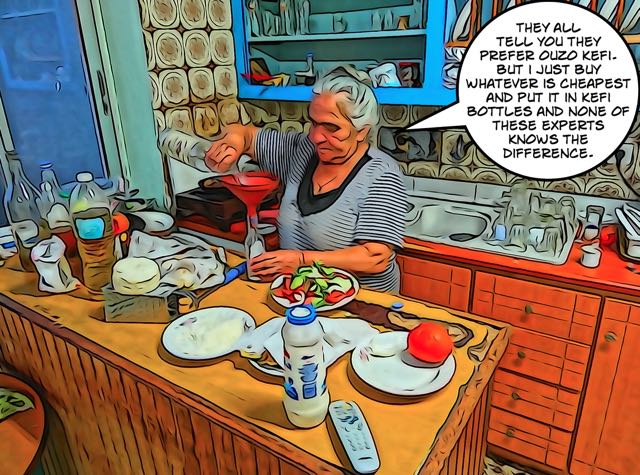 Trying to describe the taste of ouzo or to say why I prefer one to another is hard. Not
that each ouzo does not have it's own taste and subtle differences. There just are not enough ouzo connoisseurs
communicating with each other to put together a lexicon of descriptive words for ouzo. I could borrow from the
wine experts terms like fruity, and tasty but they don't work for ouzo. I could move up to the words used
to describe the finest whiskeys and scotch, but ouzo does not have the same mystique or pedigree. It hasn't been
aged for 12 years in oaken casks or had people waiting in anticipation of this years batch. It's pretty much cooked or mixed together, bottled and shipped out. If one has a favorite ouzo it is probably not because they prefer one grape to another (who
says they all use grapes anyway?). It is usually because they like the flavor that the ingredients added to the
alcohol give it, they like the higher or lower percent of alcohol, or they like the color of the bottle or the
advertisements for it. As our Aunt Aglaia says of the old men who visit her cafe in Xidira, each one an expert on ouzo with his own personal preference "I
buy in bulk whatever is cheapest and put it in whatever bottle I have. If I buy Veto and all I have is an Empty bottle
of Kefi I put it in a bottle of Kefi and nobody has ever said to me "Hey. This is not Kefi!" in all the
years I have been working." Trying to describe the taste of ouzo or to say why I prefer one to another is hard. Not
that each ouzo does not have it's own taste and subtle differences. There just are not enough ouzo connoisseurs
communicating with each other to put together a lexicon of descriptive words for ouzo. I could borrow from the
wine experts terms like fruity, and tasty but they don't work for ouzo. I could move up to the words used
to describe the finest whiskeys and scotch, but ouzo does not have the same mystique or pedigree. It hasn't been
aged for 12 years in oaken casks or had people waiting in anticipation of this years batch. It's pretty much cooked or mixed together, bottled and shipped out. If one has a favorite ouzo it is probably not because they prefer one grape to another (who
says they all use grapes anyway?). It is usually because they like the flavor that the ingredients added to the
alcohol give it, they like the higher or lower percent of alcohol, or they like the color of the bottle or the
advertisements for it. As our Aunt Aglaia says of the old men who visit her cafe in Xidira, each one an expert on ouzo with his own personal preference "I
buy in bulk whatever is cheapest and put it in whatever bottle I have. If I buy Veto and all I have is an Empty bottle
of Kefi I put it in a bottle of Kefi and nobody has ever said to me "Hey. This is not Kefi!" in all the
years I have been working."
|
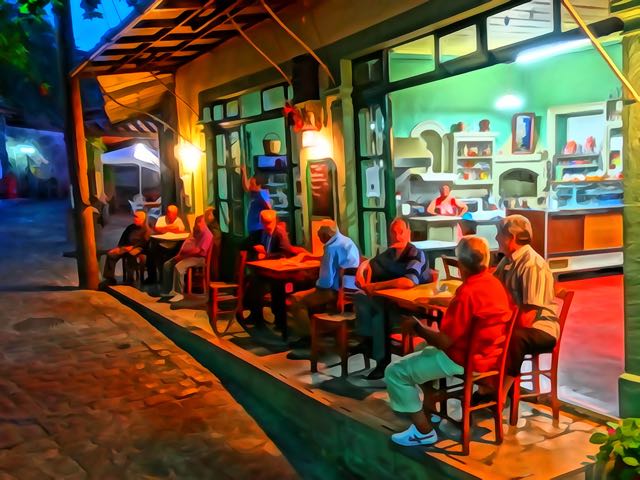 I have to face the fact that while in Lesvos, ouzo is my life. I am not ashamed, nor do
I consider myself an alcoholic (who does?). I spend the day doing various activities like writing, reading, swimming,
visiting places, until the sun goes down when I walk down to the cafeneons in the village of Vatousa and order my first ouzo and meze. I
know that I may drink two glasses or I may drink ten, but in the course of those ten glasses I am going to have
interesting conversations, meet a stranger or two, be bought an ouzo, practice my Greek, watch my wife and child
head home to bed, and end up talking to the cafe owner about something I know from living in America that he is
curious about. I may have the opportunity to explain to someone who tends sheep for a living what the internet is, or why it's not necessary for a baseball pitcher to throw a strike on an 0 and two count. I have to face the fact that while in Lesvos, ouzo is my life. I am not ashamed, nor do
I consider myself an alcoholic (who does?). I spend the day doing various activities like writing, reading, swimming,
visiting places, until the sun goes down when I walk down to the cafeneons in the village of Vatousa and order my first ouzo and meze. I
know that I may drink two glasses or I may drink ten, but in the course of those ten glasses I am going to have
interesting conversations, meet a stranger or two, be bought an ouzo, practice my Greek, watch my wife and child
head home to bed, and end up talking to the cafe owner about something I know from living in America that he is
curious about. I may have the opportunity to explain to someone who tends sheep for a living what the internet is, or why it's not necessary for a baseball pitcher to throw a strike on an 0 and two count. |
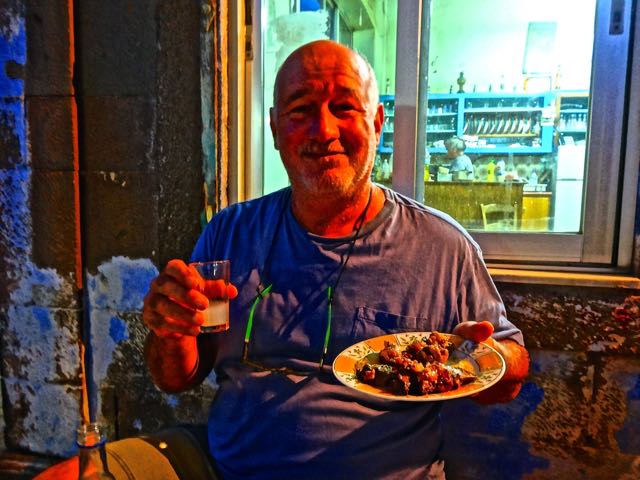 Occasionally on a Sunday I will drive over to Xidera, the most remote village in Lesvos,
where my wife's family is from, and visit with my friends who live there. Most of them are old men though there are a few
my age like Thanasis the Australian who owns the cafeneon directly across the small street from Andrea's aunt Aglaia
who is the finest one burner cook in all of Lesvos. When we visit she makes grand feasts for us to be washed down with ouzo. Her
husband Panayotis was the village butcher and passed the trade on to his son Stavros, so one of the staple
mezes are the fried organs of whatever he has killed recently, usually a sheep or goat. It is called sikotaria and I think it's a staple or else she only serves them to me to get rid of them. Regardless, whenever I sit down with Uncle Panayotis and he offers me an ouzo, I know there
is a spleen not far behind. But it is usually followed by fried kolokithia (zucchini), meletsanes (eggplants) and dolmades and her arni keftedes (lamb meatballs), a tomato, piece of cheese, and everything comes from the village (except the ouzo). Occasionally on a Sunday I will drive over to Xidera, the most remote village in Lesvos,
where my wife's family is from, and visit with my friends who live there. Most of them are old men though there are a few
my age like Thanasis the Australian who owns the cafeneon directly across the small street from Andrea's aunt Aglaia
who is the finest one burner cook in all of Lesvos. When we visit she makes grand feasts for us to be washed down with ouzo. Her
husband Panayotis was the village butcher and passed the trade on to his son Stavros, so one of the staple
mezes are the fried organs of whatever he has killed recently, usually a sheep or goat. It is called sikotaria and I think it's a staple or else she only serves them to me to get rid of them. Regardless, whenever I sit down with Uncle Panayotis and he offers me an ouzo, I know there
is a spleen not far behind. But it is usually followed by fried kolokithia (zucchini), meletsanes (eggplants) and dolmades and her arni keftedes (lamb meatballs), a tomato, piece of cheese, and everything comes from the village (except the ouzo). |
|
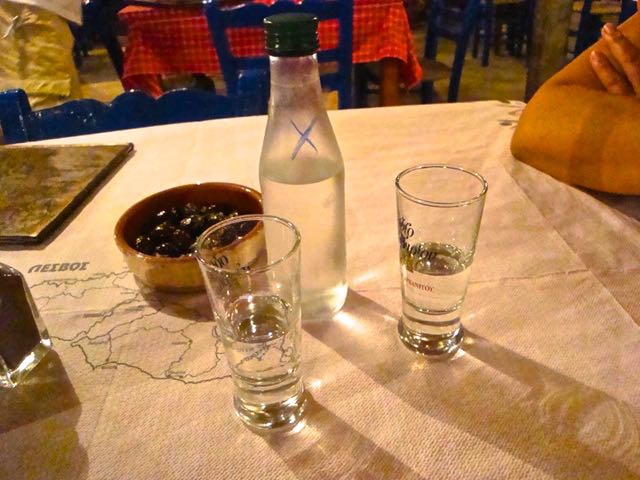 Andrea's uncle Mitzo was famous for his xima. He called it ouzo but it tasted nothing like ouzo and a lot like moonshine, raki and tsipuro. It
shared an element with all three. It could knock you on your ass in no time flat. There was an old still in his
garden where he used to make his ouzo. He would sing to us: Andrea's uncle Mitzo was famous for his xima. He called it ouzo but it tasted nothing like ouzo and a lot like moonshine, raki and tsipuro. It
shared an element with all three. It could knock you on your ass in no time flat. There was an old still in his
garden where he used to make his ouzo. He would sing to us:
Otan kapnizi oh loulas
esi then prepi na milas
kitaxe trigiro i mages
kanoun oloi toumpeki
or
When you light the loulas
you must not speak
look around at the "manges"
they are all making "toumpki" (cutting the
tobacco into pieces )
These are the lyrics from an old Rembetika song by Mitsakis that are actually about
smoking hashish, but Uncle Mitso had his own meaning, the key obviously resting on the translation of the word loulas. Unlike the commercial ouzo, his came from his own grapes.
Even after he could no longer drink he continued to make his ouzo to share with friends and family and unsuspecting
visitors.
|
|
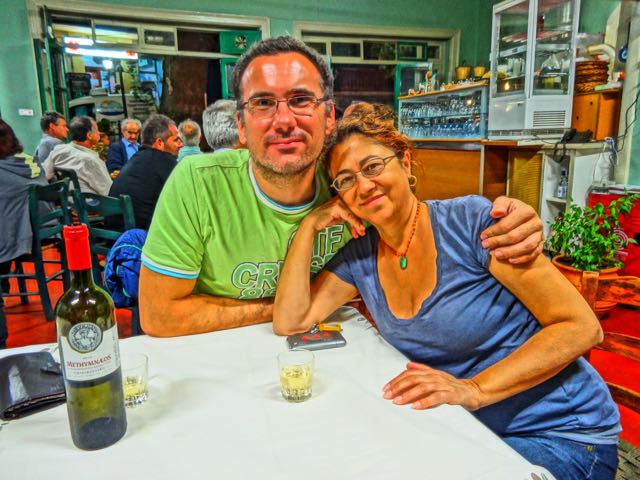 So why is ouzo such a big deal on Lesvos? Not many people outside of Lesvos realize that their grapes were wiped out by a blight several hundred years ago and have not been grown except in private gardens, up until the last few years. Most of the wine served in Lesvos was either the commercial
variety from the mainland or excellent local xima
wine from the nearby island of Lemnos. It is only recently that
wine from Lesvos has been re-introduced thanks to a grafting technique that has made a variety of blight resistant
grapes. In the past the island was famous for its wine because the soil and climate are perfect for it, particulary in the area around Vatousa, Xidira and Antissa which are actually in the caldera of an enormous extinct volcano. Xidira, the village famous for having more cafeneons per capita than just about anywhere in Greece, is now home to Methymnaos Winery who have been making award winning wines. Perhaps
now we are witnessing the dawn of the new age of Lesvos wines. So will wine displace ouzo as the drink of choice in the cafeneons of Lesvos? I suppose it is possible. I have met a lot of people my age who say they can't drink ouzo anymore. Wine is one step closer to sobriety. So why is ouzo such a big deal on Lesvos? Not many people outside of Lesvos realize that their grapes were wiped out by a blight several hundred years ago and have not been grown except in private gardens, up until the last few years. Most of the wine served in Lesvos was either the commercial
variety from the mainland or excellent local xima
wine from the nearby island of Lemnos. It is only recently that
wine from Lesvos has been re-introduced thanks to a grafting technique that has made a variety of blight resistant
grapes. In the past the island was famous for its wine because the soil and climate are perfect for it, particulary in the area around Vatousa, Xidira and Antissa which are actually in the caldera of an enormous extinct volcano. Xidira, the village famous for having more cafeneons per capita than just about anywhere in Greece, is now home to Methymnaos Winery who have been making award winning wines. Perhaps
now we are witnessing the dawn of the new age of Lesvos wines. So will wine displace ouzo as the drink of choice in the cafeneons of Lesvos? I suppose it is possible. I have met a lot of people my age who say they can't drink ouzo anymore. Wine is one step closer to sobriety.
|
Ouzo=Kefi
 Ouzo can be a kefi-catalyst, an infusion of life-force that can make a colorless world seem vibrant and nothing seems important beyond the now. My first day in Lesvos a couple years ago was a Sunday which is a popular day in the cafeneons when spontaneous explosions of kefi are not uncommon. What
I mean by kefi is a feeling that comes over one that can only be expressed by dancing, singing or radiating (sitting there and glowing with happiness which is what I do). We were sitting in a corner of Tryphon's cafeneon while in the other corner sat a group of young and old men who would burst into song when one of the tunes being played struck a chord within them. The finest singer of them all was a young carpenter and stone mason named Panayotis who every so often when he was really filled with kefi
would leap to his feet to dance. Not for us, not for his friends or anyone else in the cafeneon (which was empty except for us), but for himself. He was lost in the music,
the moment and the movement. He was expressing himself to himself and we were blessed to be witnesses. It was really very spiritual, like watching lovers, or a holy man talking to God and realizing that God is indeed listening. Ouzo can be a kefi-catalyst, an infusion of life-force that can make a colorless world seem vibrant and nothing seems important beyond the now. My first day in Lesvos a couple years ago was a Sunday which is a popular day in the cafeneons when spontaneous explosions of kefi are not uncommon. What
I mean by kefi is a feeling that comes over one that can only be expressed by dancing, singing or radiating (sitting there and glowing with happiness which is what I do). We were sitting in a corner of Tryphon's cafeneon while in the other corner sat a group of young and old men who would burst into song when one of the tunes being played struck a chord within them. The finest singer of them all was a young carpenter and stone mason named Panayotis who every so often when he was really filled with kefi
would leap to his feet to dance. Not for us, not for his friends or anyone else in the cafeneon (which was empty except for us), but for himself. He was lost in the music,
the moment and the movement. He was expressing himself to himself and we were blessed to be witnesses. It was really very spiritual, like watching lovers, or a holy man talking to God and realizing that God is indeed listening.
|
Helpful Ouzo Information
|
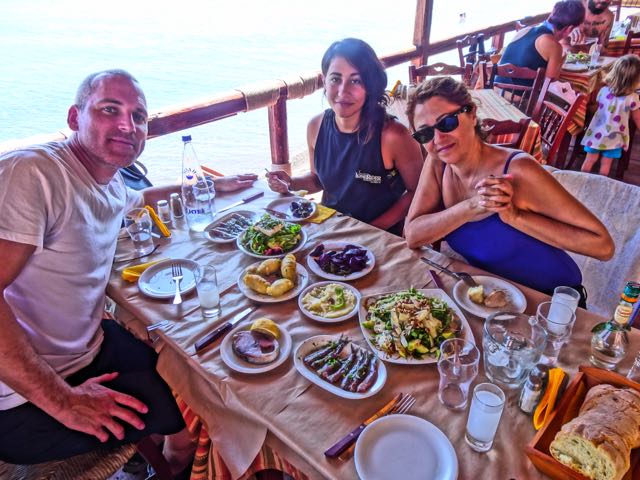 If you are on the island of Lesvos there are lots of places where you can get good ouzo with great food and very nice atmosphere. My favorite ones are Cavo d Oro or Remezzo's in Sigri, Blue Sardine, Soulatso or Adonis in Skala Eressos, Captain's Table or Eftalou
Taverna in Molyvos, Akrotiri Taverna or Aphrodite Taverna in Vatera, Grigoris in Nifidi and any of the restaurants in the old harbor in Mytilini. All these places will have sardeles pastes and other seafood mezedes and they are all right on the sea. Cafeneon Ermis in Mytilini is probably the most famous cafeneon-ouzeri on the island and you should make a point of going there or go across the street to Kastro which is also an ouzeri. But you can have food that is just
as good, or even better at just about any traditional cafeneon in almost any village in Lesvos, whether it is on the sea of in the mountains or somewhere in between. For more restaurants in Lesvos see my Lesvos Restaurant Guide. If you are on the island of Lesvos there are lots of places where you can get good ouzo with great food and very nice atmosphere. My favorite ones are Cavo d Oro or Remezzo's in Sigri, Blue Sardine, Soulatso or Adonis in Skala Eressos, Captain's Table or Eftalou
Taverna in Molyvos, Akrotiri Taverna or Aphrodite Taverna in Vatera, Grigoris in Nifidi and any of the restaurants in the old harbor in Mytilini. All these places will have sardeles pastes and other seafood mezedes and they are all right on the sea. Cafeneon Ermis in Mytilini is probably the most famous cafeneon-ouzeri on the island and you should make a point of going there or go across the street to Kastro which is also an ouzeri. But you can have food that is just
as good, or even better at just about any traditional cafeneon in almost any village in Lesvos, whether it is on the sea of in the mountains or somewhere in between. For more restaurants in Lesvos see my Lesvos Restaurant Guide. |
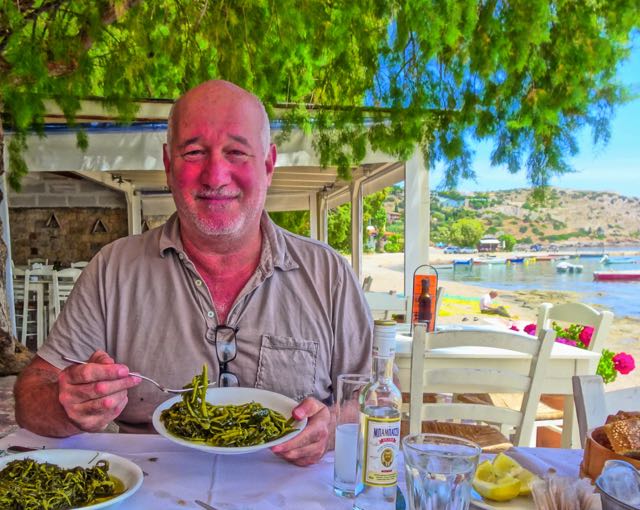 In Athens I recommend the Ouzeri Lesvos on Emanual Benaki Street between Omonia Square and the neighborhood of Exarchia, which will make you feel like you are in Lesvos. In Plaka I recommend To Cafeneon which is on Epiharmnou street between Apollonos Street and the Acropolis. In Psiri I recommend Cafe
Evi and Atlantiko which are just around the corner from each other and both have a large selection of ouzos and plenty of mezedes. Atlantiko specializes in fish. Also Mavros Gatos right up the street is really good. In Kypseli O Bakalogatos has mezedes from all over Greece and a nice selection of ouzo and tsipuro. But there are hundreds of mezedopouleions and ouzeries in Athens, in particular the neighborhoods of Gazi, Monastiraki (next to the train tracks), Thission, Koukaki,
Exarchia, and Petralona. If you go to the coast around Athens there are lots of places to drink ouzo and eat seafood, especially in Anavissos, Glyfada, Rafina, and Lavrion. See my Athens Guide Restaurant Page for more. In Athens I recommend the Ouzeri Lesvos on Emanual Benaki Street between Omonia Square and the neighborhood of Exarchia, which will make you feel like you are in Lesvos. In Plaka I recommend To Cafeneon which is on Epiharmnou street between Apollonos Street and the Acropolis. In Psiri I recommend Cafe
Evi and Atlantiko which are just around the corner from each other and both have a large selection of ouzos and plenty of mezedes. Atlantiko specializes in fish. Also Mavros Gatos right up the street is really good. In Kypseli O Bakalogatos has mezedes from all over Greece and a nice selection of ouzo and tsipuro. But there are hundreds of mezedopouleions and ouzeries in Athens, in particular the neighborhoods of Gazi, Monastiraki (next to the train tracks), Thission, Koukaki,
Exarchia, and Petralona. If you go to the coast around Athens there are lots of places to drink ouzo and eat seafood, especially in Anavissos, Glyfada, Rafina, and Lavrion. See my Athens Guide Restaurant Page for more. |
|
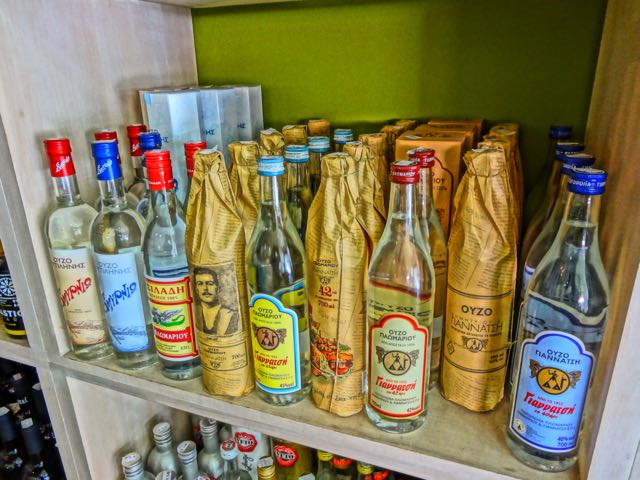 If you are interested in trying or purchasing Ouzo Plomari by Giannatsi you can come to their new modern factory in the hills above the town of Plomari on the road to Melinda. They will be happy to explain what makes their ouzo so good. If you
love ouzo it is worth the trip. Or ask for it in your local cafeneon or ouzerie. Or visit the Barbagiannis Ouzo Museum a few blocks from the center of Plomari on the road to Mytilini. There is also the Mattis Ouzo Factory and shop right in the market in Mytilini. But you don't have to go all the way to Lesvos to buy good ouzo. You can find all the Lesvos ouzos at the Lesvos Shop on Athinas Street in Athens right next to the Hotel Attalos. You can also find most brands of Lesvos Ouzo
as well as ouzo from the rest of Greece at Angelo the Ouzo King's Ouzo and Traditional Gifts Shop in
the Plaka on Adrianou Street. Don't wait to get to the airport to do your ouzo shopping because your choices will be limited. If you are interested in trying or purchasing Ouzo Plomari by Giannatsi you can come to their new modern factory in the hills above the town of Plomari on the road to Melinda. They will be happy to explain what makes their ouzo so good. If you
love ouzo it is worth the trip. Or ask for it in your local cafeneon or ouzerie. Or visit the Barbagiannis Ouzo Museum a few blocks from the center of Plomari on the road to Mytilini. There is also the Mattis Ouzo Factory and shop right in the market in Mytilini. But you don't have to go all the way to Lesvos to buy good ouzo. You can find all the Lesvos ouzos at the Lesvos Shop on Athinas Street in Athens right next to the Hotel Attalos. You can also find most brands of Lesvos Ouzo
as well as ouzo from the rest of Greece at Angelo the Ouzo King's Ouzo and Traditional Gifts Shop in
the Plaka on Adrianou Street. Don't wait to get to the airport to do your ouzo shopping because your choices will be limited.
|
Buying Ouzo (and Raki) Outside of Greece
 You can't get most of the ouzos I recommend in the US. Even in Astoria, New York, a neighborhood full of Greeks we could only find Barbagiannis Blue, Arvanitis and the usual commercial stuff cranked out by the big ouzo exporters for a clientele that they think can't tell the difference between
ouzo and licorice flavored rubbing alcohol. However you can buy ouzo on-line from Greece and Grapes, including their Ouzo Tasting Pack which features several of my favorite ouzos that I wrote about... So if you love the information on my web site and you want to send me a gift buy a bottle of Babatzim,
Dimino, Pitsalidi, Barbayiannis (green) or Gianatsi and send it to me at 102 Old Pittsboro Rd, Carrboro, NC 27510 USA. If I get enough maybe I will open an ouzeri! You can't get most of the ouzos I recommend in the US. Even in Astoria, New York, a neighborhood full of Greeks we could only find Barbagiannis Blue, Arvanitis and the usual commercial stuff cranked out by the big ouzo exporters for a clientele that they think can't tell the difference between
ouzo and licorice flavored rubbing alcohol. However you can buy ouzo on-line from Greece and Grapes, including their Ouzo Tasting Pack which features several of my favorite ouzos that I wrote about... So if you love the information on my web site and you want to send me a gift buy a bottle of Babatzim,
Dimino, Pitsalidi, Barbayiannis (green) or Gianatsi and send it to me at 102 Old Pittsboro Rd, Carrboro, NC 27510 USA. If I get enough maybe I will open an ouzeri!
|
|
Read about Mezedes too
|
|