|
|
|
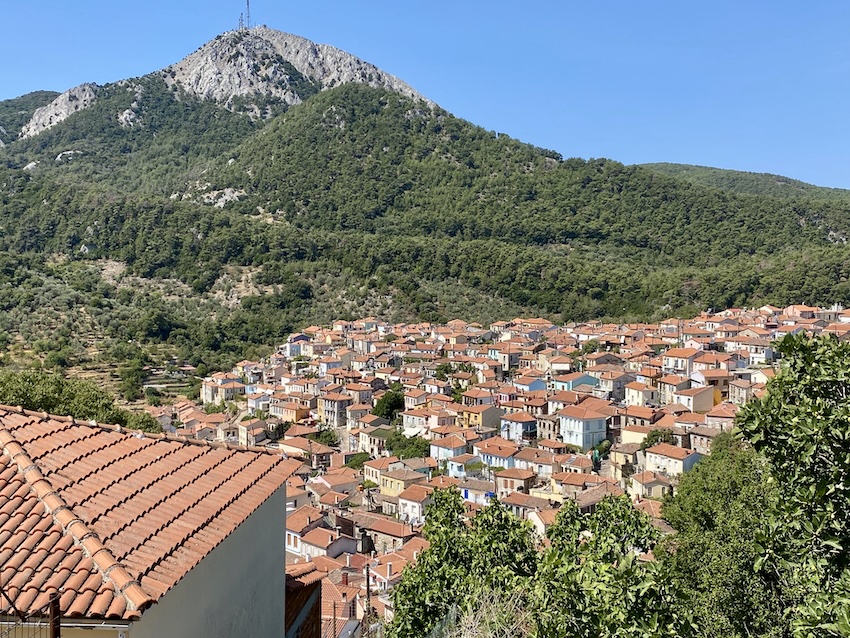
Agiassos
is 26 kilometers from Mytilini town on the
pine and olive covered slopes of Mount
Olympos. The amount of geenery here is
stunning. There are plentiful platanos, apple,
chestnut, pear and cherry trees as well as
varieties of other trees and shrubs. The town
itself is a completely traditional village of
narrow stone streets and picturesque lanes.
Many of the houses have projecting upper
floors known as
sachnisia
with
wooden balconies decorated with flower pots of
begonias, carnations, geraniums and other
ornamental plants. The industrious women of
Agiassos still spin and weave. For many years
the town was known for its pottery and this
tradition is carried on today. There is also a
high level of wood-carving. The craftsmen make
beautiful carved wooden icons and
furniture. |
|
|
|
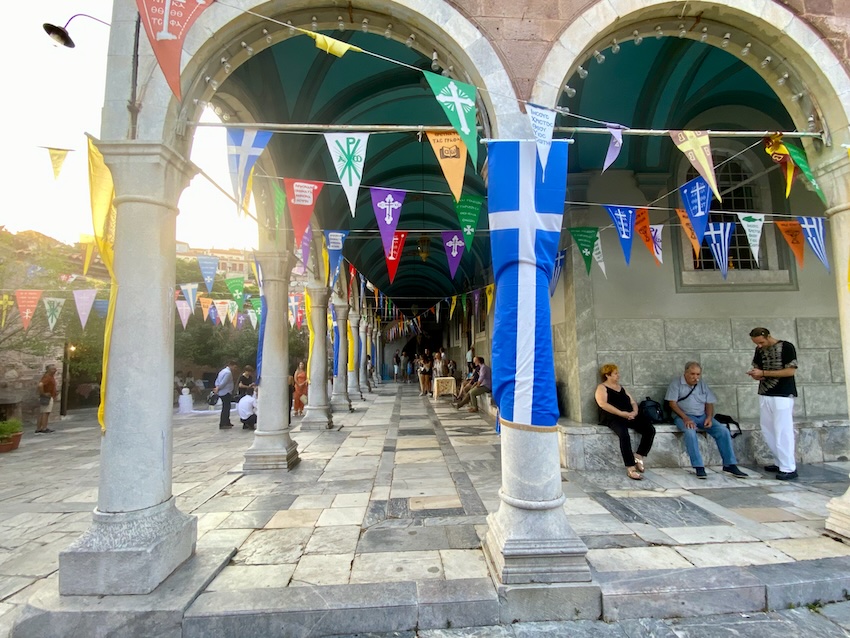
Agiassos
is known throughout Greece for the church
to the Virgin Mary, the Panagia ti
Vrefokratousa in the center of town. It is
second only to the island of Tinos for
pilgrims who used to walk the old stone road
from Mytilini to pay tribute to the miracle
working icon, brought here from Jerusulem by
the imperial priest Agathon the Ephesian in
the year 803. In 1701 Agiassos, because of a
miracle by the Blessed Virgin who cured the
Turkish administrator of an illness, was
absolved by Sultan's decree of having to pay
taxes to the Ottoman government and many
people moved there until it was recinded in
1783. Pilgrims still come throughout the year
but especially on the eve of the feast day of
the Panagia (August 15th). The
worshippers come into the monk cells and the
church enclosure, many of them having spent 15
days waiting outside. Some still walk from all
over the island to give offerings to the icon.
After the service the icon is paraded around
with great pomp. The festival also attracts
many merchants and there is a great deal of
celebration in the nightspots of the town. It
is quite a party and the musicans keep it
going until dawn. |
|
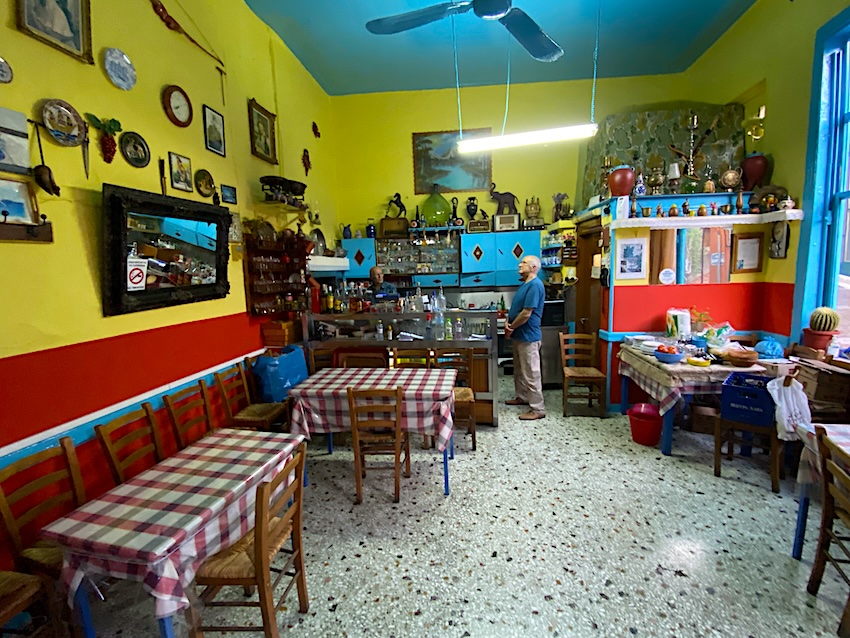
To Exarxaia Kafeneion
|
|
The
center of activity revolves around the
many cafeneons that surround the church and
some others in the upper village. Men drink
ouzo and eat special meze dishes that are
cooked by the cafe proprietors. The village is
at a high enough altitude to be cool in the
hot summer months and once you get a feel for
life there you will never miss the
beach.
Since most of the
island's tourist activity takes place on the
beaches and the coastal towns, places like
Agiassos have maintained their traditions and
time spent here is similar to the way it would
have been 100 years ago.
In the lower part
of the village there are several restaurants
that cater to visitors, mostly Greeks and Turks who have
come to see the church and the icons. If you
are coming here by car it is recommended you
leave it here and walk up through the village
and avoid the stress of having to stop and go
on a ninety degree hill that makes San
Francisco look like the plains of Iowa.
Then walk up
through the village, see the church and find a
nice little cafe for a meal and a
drink.
There are plenty
and they are all good, depending what you are looking for.
If you want a traditional ouzo kafeneion I like To Exarxaia Oinomagereio which is the first place I ever ate sardeles pastes. |
|
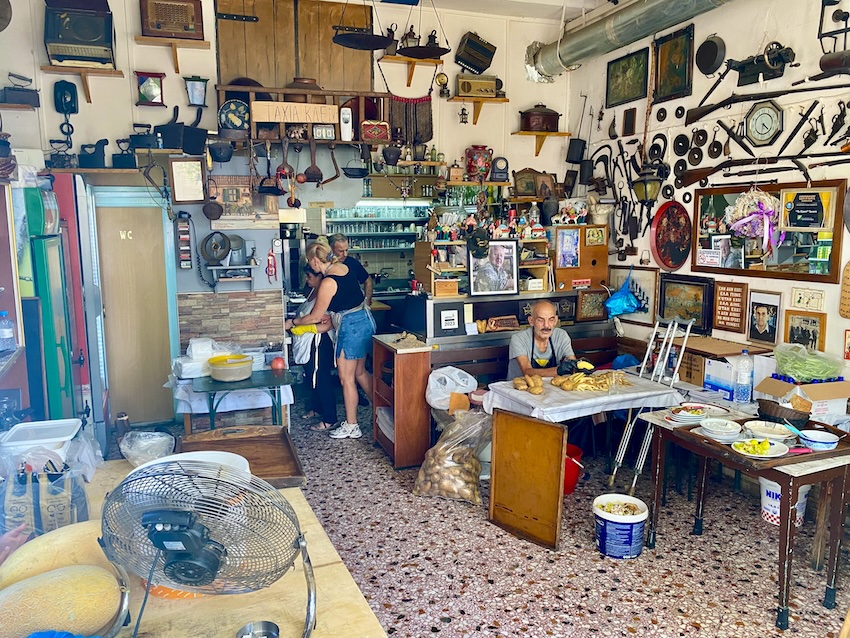
To Stavri
|
|
If you can't decide on one out of the dozens of cafeneons and restaurants in the town then I have a suggestion. Walk up the hill past the church and keep going on 25th of March Street past the medieval looking police station that looks like the kind of place that would have dungeons in the basement, and keep going until you see a bridge that crosses the main road. There are tables and chairs on each side of the bridge and on the right
is a small
ouzeri-cafeneon with a restaurant sized menu (though not an actual physical menu. Like most places the guy tells you what he has to eat and you tell him what you want.)
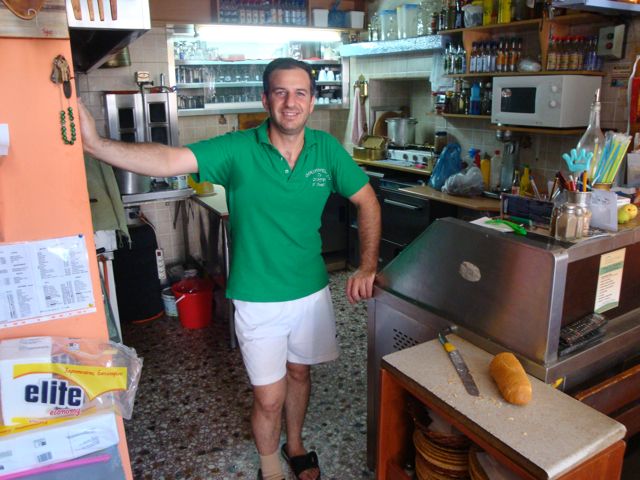 The cafeneon is called To Stavri and is owned by Vassilis Viglatsis who ran it with his father, a retired actor who passed away in 2025. Actually you can't miss the place because there are signs of idioms and philosophical advice posted on trees,
walls, the bridge and all over the place. Try the pastourma omelet, or his home made lamb keftedes which are more like patties than meatballs. He has delicious cheese-stuffed louloudakia (zucchini flowers) and an ample horiatiki salata with the best tomatoes of the summer that we had. Also their ladotiri (local cheese) is excellent, especially if you get it as saganaki, and their feta in yogurt. The restaurant is open 24 hours too (maybe) and from Septermber to June serves patsa, the miracle working
tripe that everyone in Greece eats to cure hangovers and more serious illnesses. When you sit down the waier will tell you what they have. I don't recall ever seeing a menu in Agiassos. Pretty much anything you get will be good. The inside of the restaurant is like an antique museum, in fact in some places it would be an antique museum. The cafeneon is called To Stavri and is owned by Vassilis Viglatsis who ran it with his father, a retired actor who passed away in 2025. Actually you can't miss the place because there are signs of idioms and philosophical advice posted on trees,
walls, the bridge and all over the place. Try the pastourma omelet, or his home made lamb keftedes which are more like patties than meatballs. He has delicious cheese-stuffed louloudakia (zucchini flowers) and an ample horiatiki salata with the best tomatoes of the summer that we had. Also their ladotiri (local cheese) is excellent, especially if you get it as saganaki, and their feta in yogurt. The restaurant is open 24 hours too (maybe) and from Septermber to June serves patsa, the miracle working
tripe that everyone in Greece eats to cure hangovers and more serious illnesses. When you sit down the waier will tell you what they have. I don't recall ever seeing a menu in Agiassos. Pretty much anything you get will be good. The inside of the restaurant is like an antique museum, in fact in some places it would be an antique museum.
|
|
|
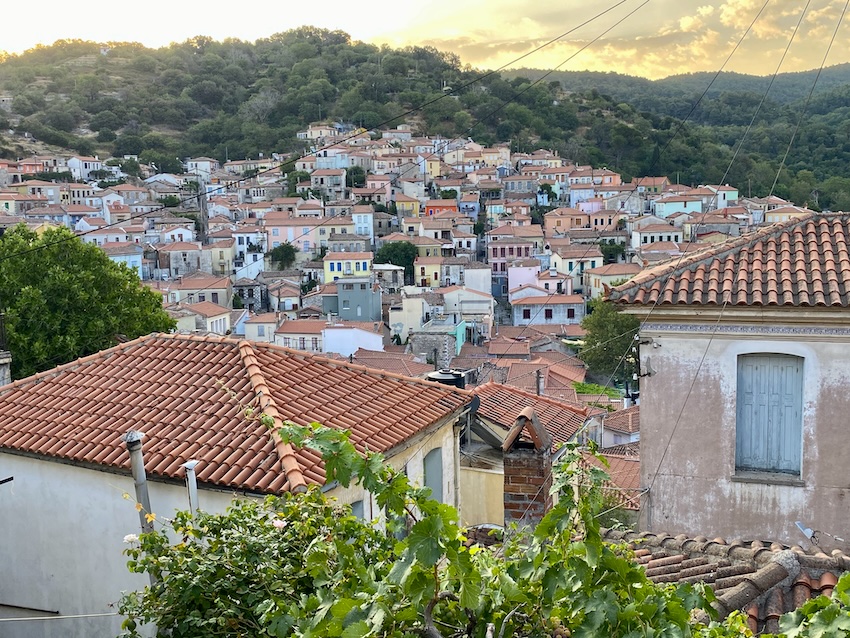
| At the top of the village if you cross the bridge and follow that road (also 25th of March Street somehow) you will come to a large flat area where you will find the old school, the church of Agia Triada, which is the second church of the village, some industrial buildings and several tavernas, kafeneions and a cafe-bar on Agia Triadas street which, if you continue on will lead you out of the village. There is parking in this section
so if
you are visiting Agiassos you can enter this way and it is less of a climb to the church and the center of town. But when we stayed here with my wife's cousins many years ago once we discovered this area it was where we spent most of our time. Not just because it seemed more authentically working class but also because it was pretty much on the same level as the cousin's house. At the time there was also a wonderful pine shaded kafeneion at the top of the village called To Famaka which was at one time
run by her family but has now been empty for years. One of my plans for retirement is to open a kafeneion there but if someone else decides to do it before me that sounds fine to me as well. |
|
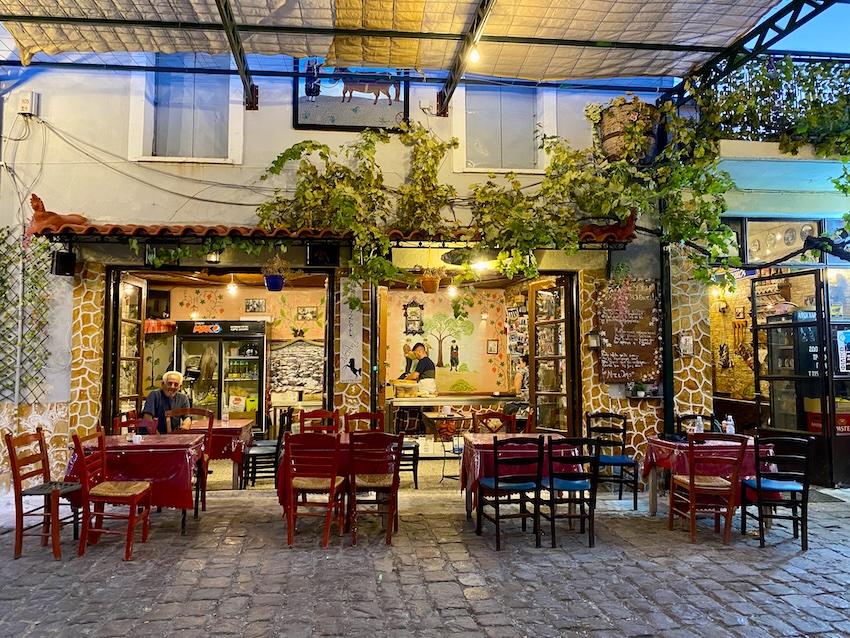
The Kafeneion/Ouzeri Ntilis right by the Church of Agia Triada is a family run restaurant with great food, good music and very friendly staff if you are looking for somewhere that feels more like a taverna. If you can't find a table (unlikely) you can try the the Gyrogonia Steak House next door.
|
|
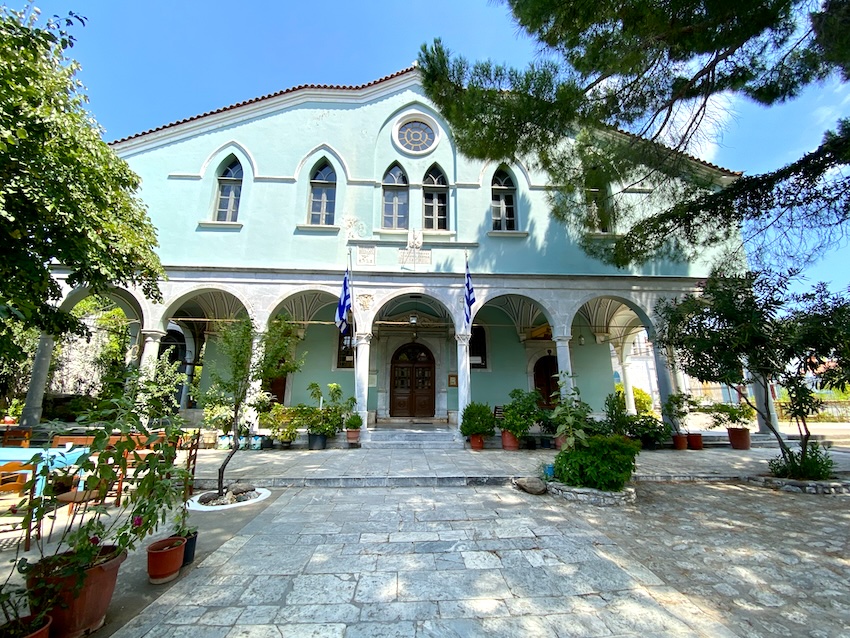
Panagia ti
Vrefokratousa gets all the attention of course but Agia Triada, built in 1870, is a beautiful church and deserves a visit if you are up in this part of the village.
|
|
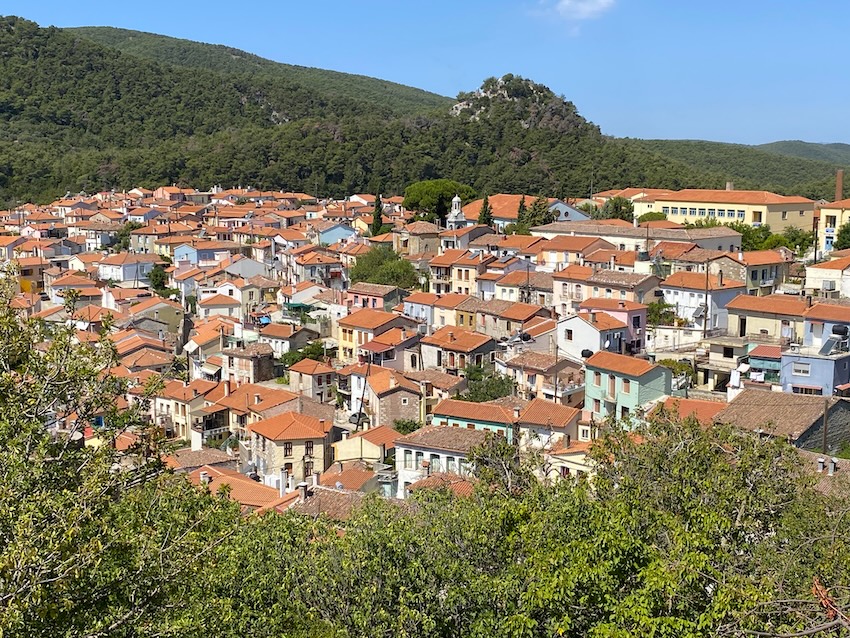
View of the Agia Triada neighborhood from the road to the Sanitarium which continues on to the towns of Megalohori and Plomari.
|
|
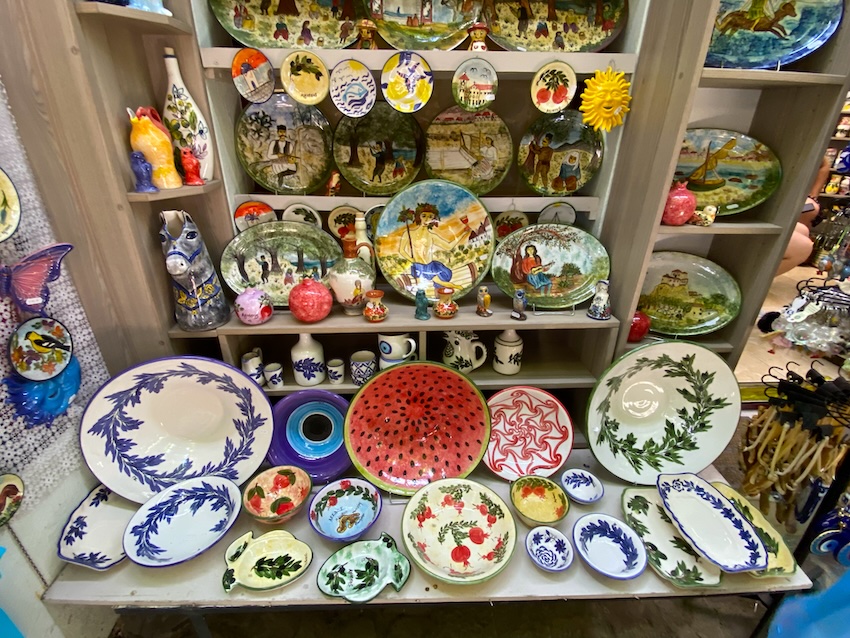
There are many tourist shops around the main church in the center of Agiassos including the famous ceramic shop of Yota Soulakelli whose beautiful work can be found in the households of just about everyone I know in Lesvos and even some people in Athens.
|
|
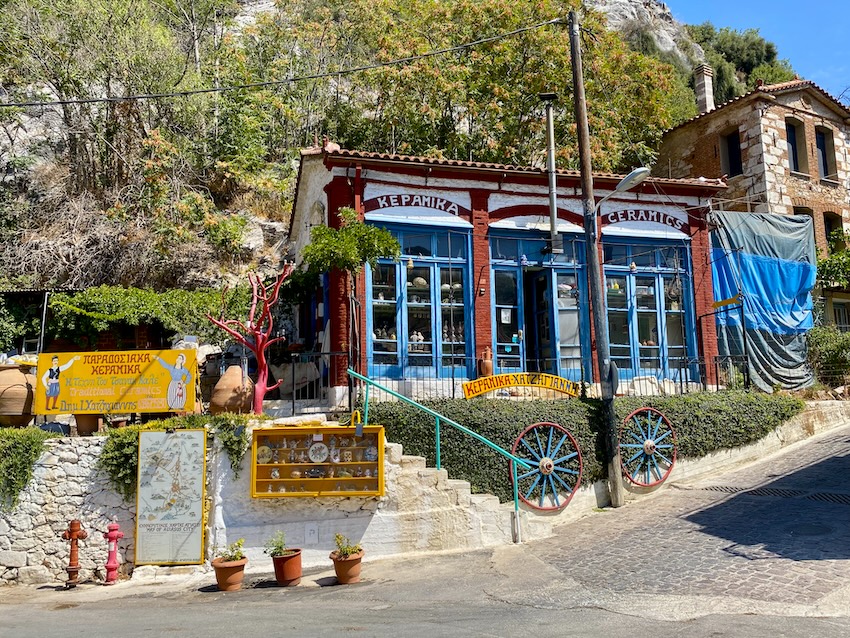
But if you are parking at the bottom of the village visit the workshop of the ceramic artist Dimitris Hatzigiannis to see some truly unique work. His shop is hard to miss. You can see his work
on his Facebook Page.
|
|
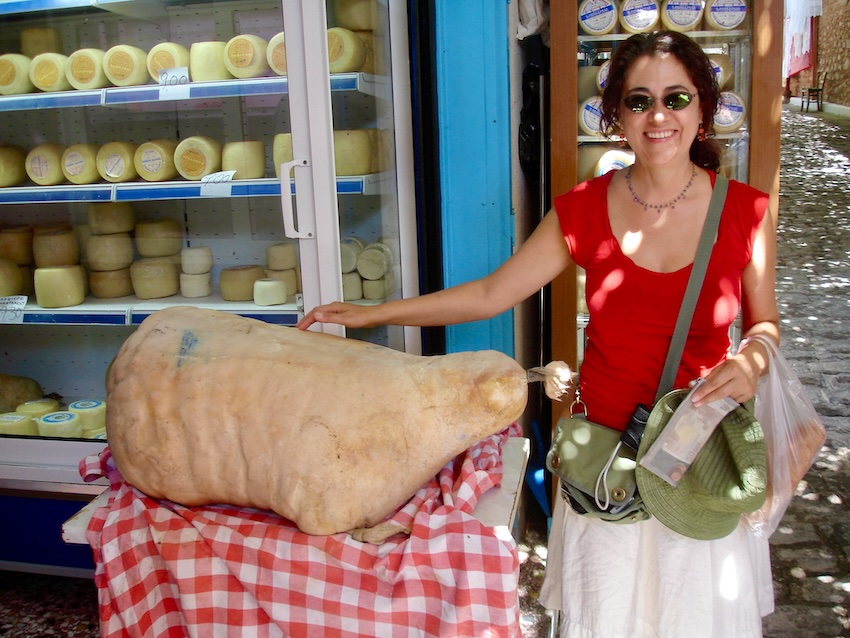
Touloumotiri is a sheep cheese that is aged in the skin of a sheep or goat for several months and sold in several of the cheese shops next to the church along with many other cheeses from around Lesvos. Ask for a taste and probably you will want to buy some. Other cheeses that you can get include the ladotiri, kefalograviera and kaseri from Xidira which is my my favorite cheese company so far. The butcher
shop on the back side of the church makes his own soft ladotiri. Most of the cheeses of Lesvos are made from sheep's milk as are the yogurts, and if you can find it, the ice cream from Mesotopos.
|
|
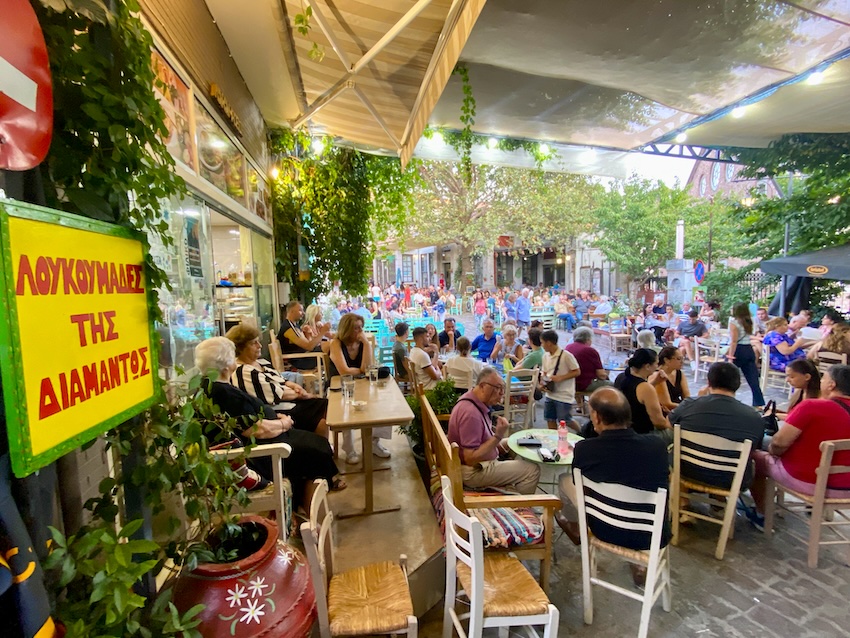
If you love loukamades there are at least 5 cafes that sell them around the church and probably more scattered around the village. When I walked around the platia at 8pm the cafes were full of people eating loukamades. When I returned after dinner at around 11pm they were still full of people eating loukoumades.
|
|
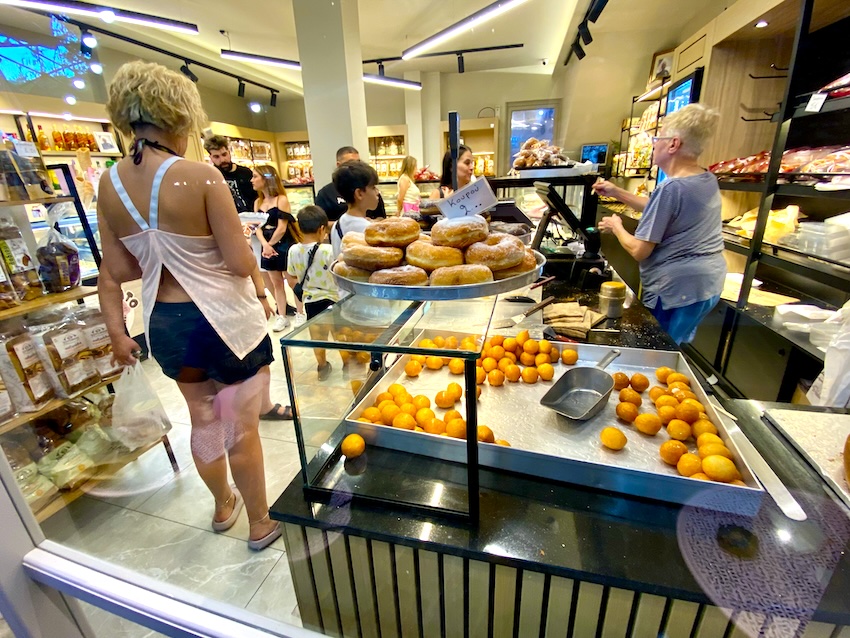
What are loukoumades? These are loukoumades. Deep fried dough covered in honey or other sweet things and are one reason that over a million people in Greece suffer from Diabetes. That's around 12% of the country. But eating them once in Agiassos is probably not going to make you one of them so if you like sweet things try them.
|
|
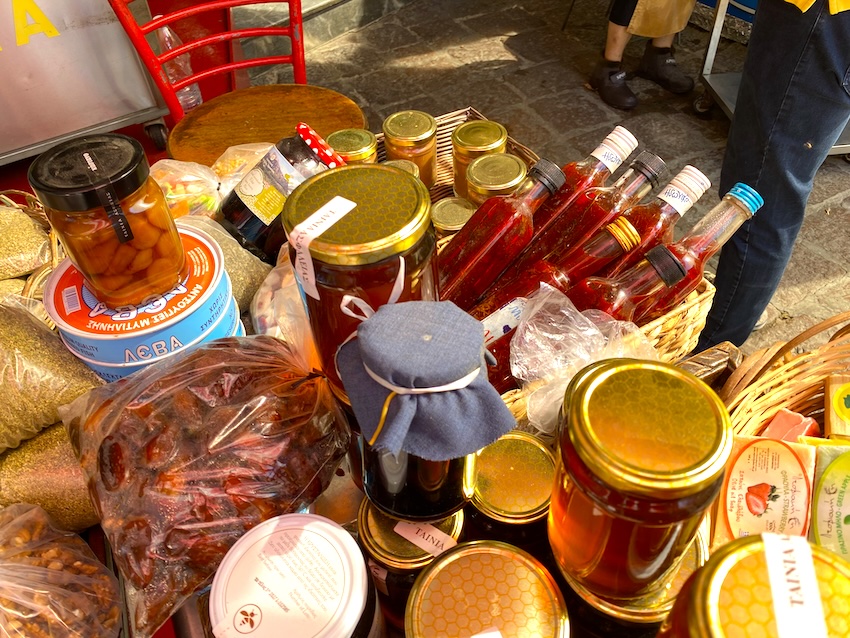
Local products for sale in the platia behind the church including spatholatho, the pink stuff in the bottles. This is an ancient cure for wounds, made from St John's Wort. The name means sword oil because those were the kinds of wounds they were used for. But it can also be effective as an anti-depressant, antiseptic, antioxidant, anti-inflammatory, for sciatica, rheumatic pain, joint pain, bruises and first-degree
burns, anxiety, obsessive-compulsive disorder (OCD), menopausal mood swings, and premenstrual syndrome. To the left are cans of the famous Lesvos sardines which pretty much do the same thing. (No, not really)
|
|
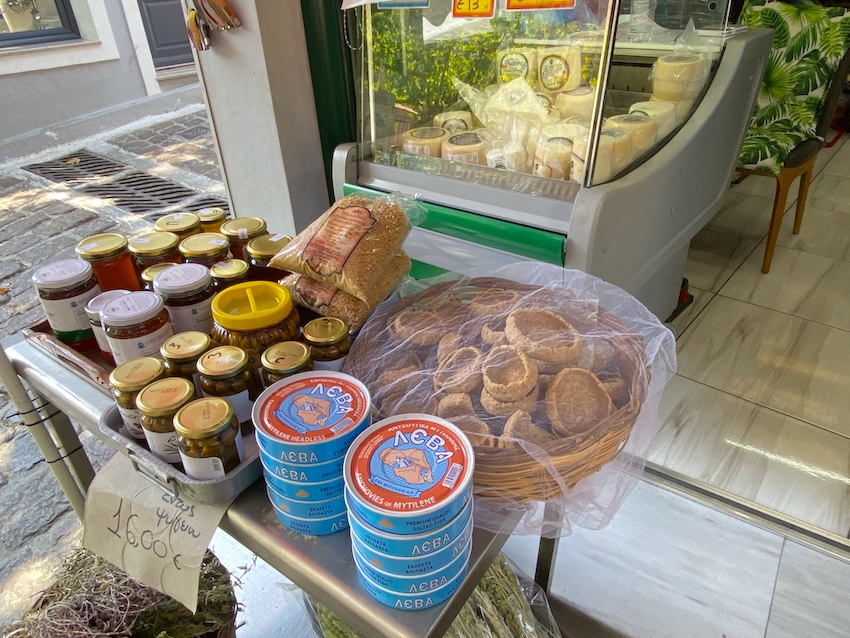
When you come to Agiassos load up on olives, cheese, canned sardnes, ouzo, herbs and spices, nuts, preserved fruit, honey, and all the other local products from around Lesvos. And don't forget to buy some trachana. What is trachana? It is an island staple made in August from wheat and sheep's milk, formed by hand into little cups, then dried on someone's roof while the women take turns guarding it for 24 hours a day until it dries because
the cats love it. They eat it all winter in soups and it even tastes good on its own like eating potato or corn chips.
|
|
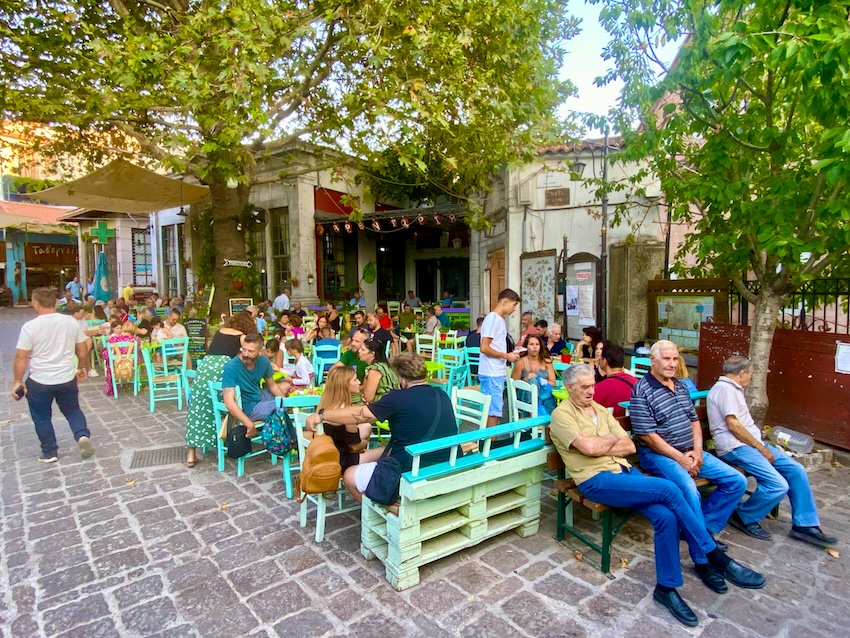
Agiassos has one of the most lively squares on the island. This is the Traditional Kafeneion Kafentaria where my wife's Uncle Yiannis used to go every day to hang out with his pals. Now her nephew Stratis is working there waiting tables (that's him in the photo actually). The family owns an old Kafeneion at the top of the village that used to be called Famaka. It looked like the bow of a ship with a long pine covered courtyard that overlooks the
village. When I found out Stratis was working at the kafeneion I told him to learn everything he can so when I retire we can reopen Famaka.
|
|
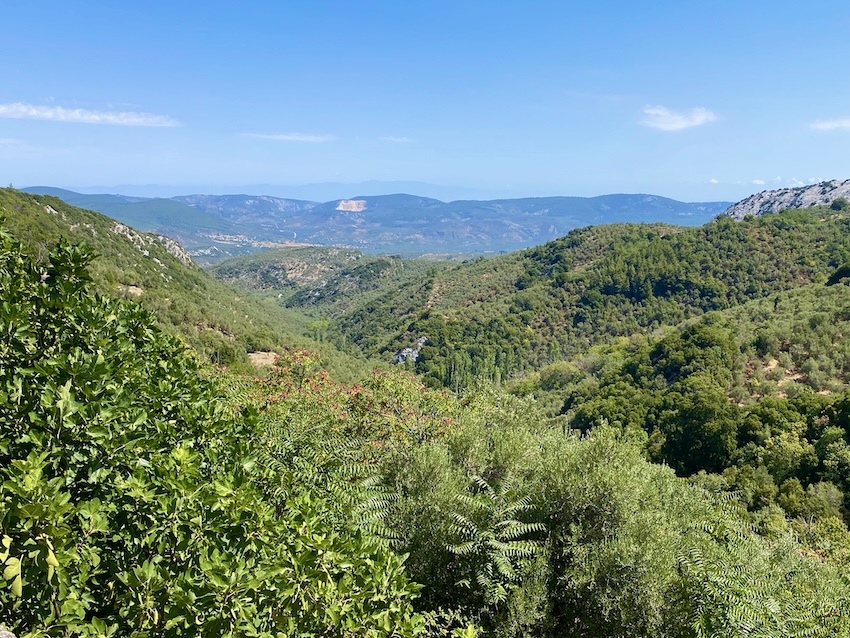
Though most visitors to the village come by car or bus there are pilgrims who walk here from Mytilini for the 15th of August using the old kalderemia, the old stone roads that used to connect all the villages. This is the view from the old Famaka Kafeneion.
|
|
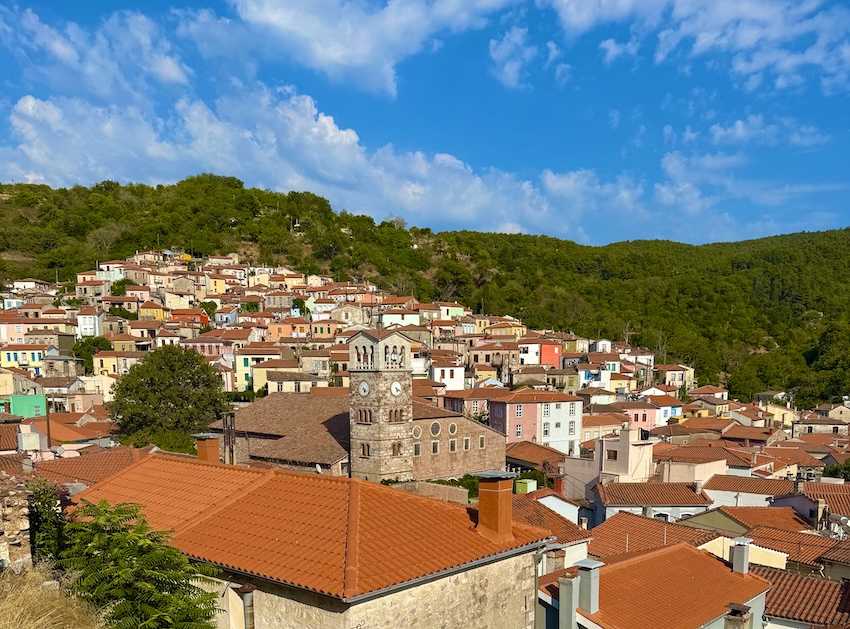
View of the town and the church
to the Virgin Mary, the Panagia ti
Vrefokratousa in the center.
|
|
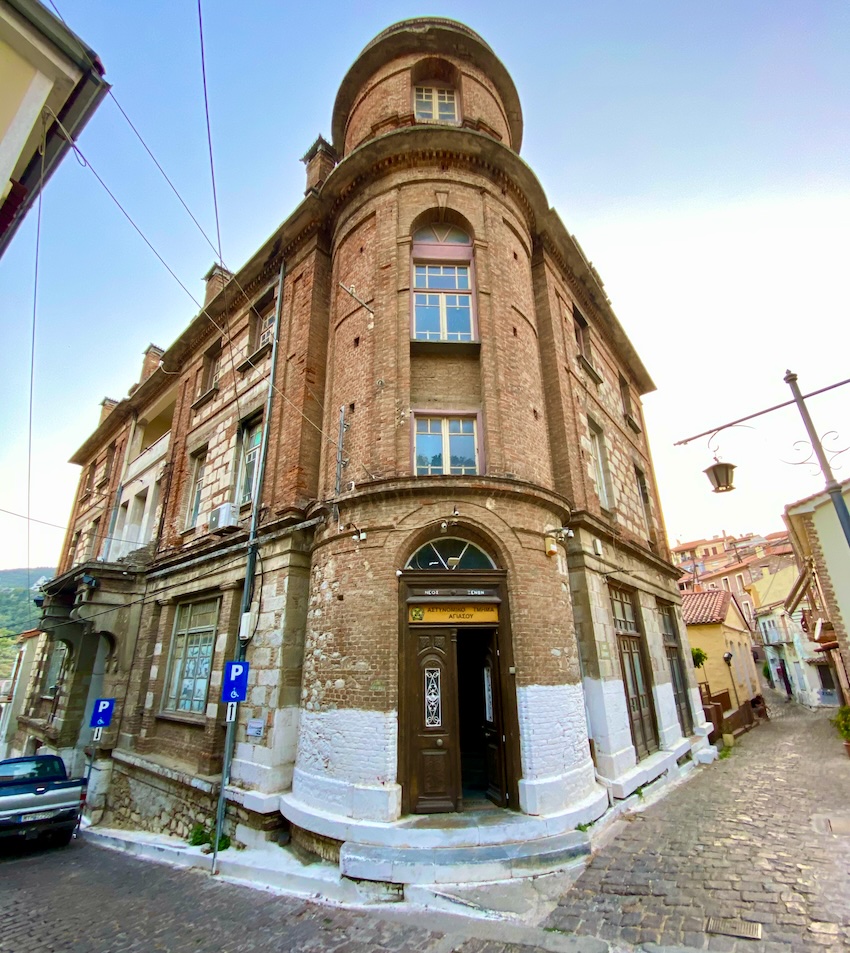
The Women's Cooperative of Agiassos have a large variety of homemade traditional foods. Their workshop is in the police department building up the street from the church. You can't miss the building. It looks like a castle.
|
|
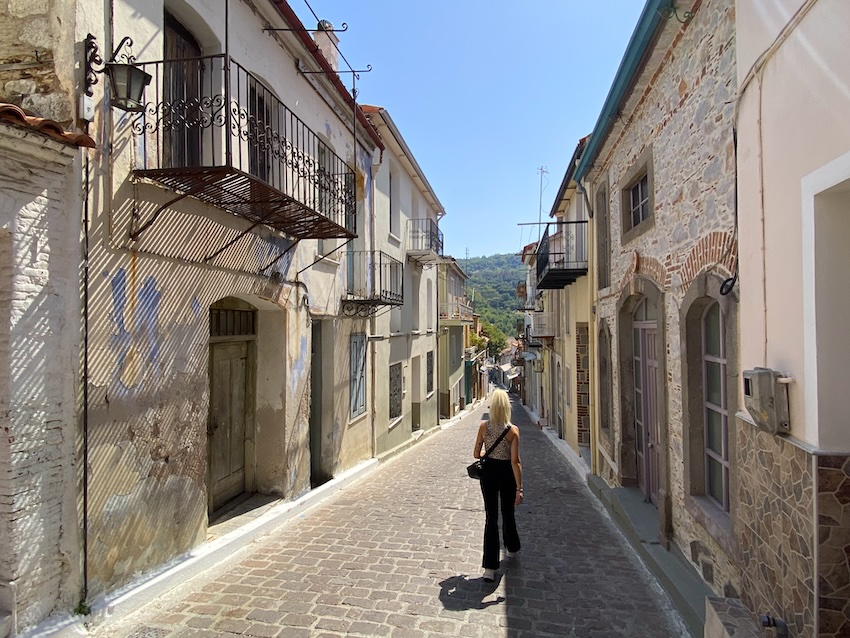
Walking down 25th of March Street towards the church. If you want to stay in shape move to this town. You will spend so much time walking up and down hills after awhile you won't even notice them. There are lots of empty houses here and like many villages in Lesvos are looking for ways of attracting people to move here and young people with roots in Agiassos to move back. If you are an artist or writer this would be a good place to
live and there are enough restaurants and cafes to keep you occupied. If you get bored you can drive to Mytilini and be in the city in half an hour.
|
|
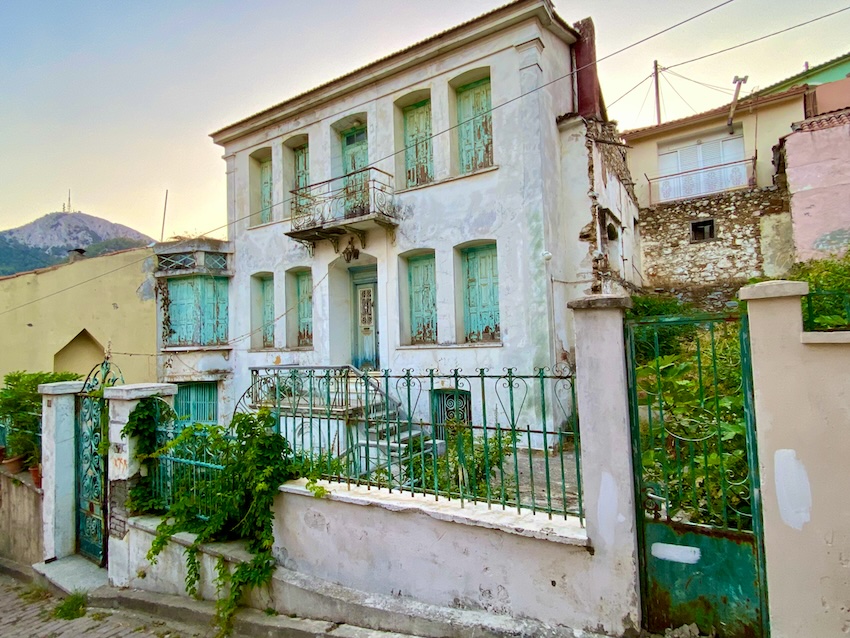
As for hotels in Agiassos the pickings are slim but you can drive here in about twenty minutes or so from Vatera Beach. If you stay in Vatera
Beach you will be on one of the best beaches on the island and within striking distance of Agiassos. Someone in Agiassos said to me "We have many hotel owners in Agiassos but they all own hotels in Vatera!" Hopefully that will change. In the meantime we stayed at a very nice place called Agiassos Stone House which was a beautiful little house in the center of town run by a very sweet woman named Stavroula. I liked the place so much that I put it on my website. See Agiassos Stone House
|
|
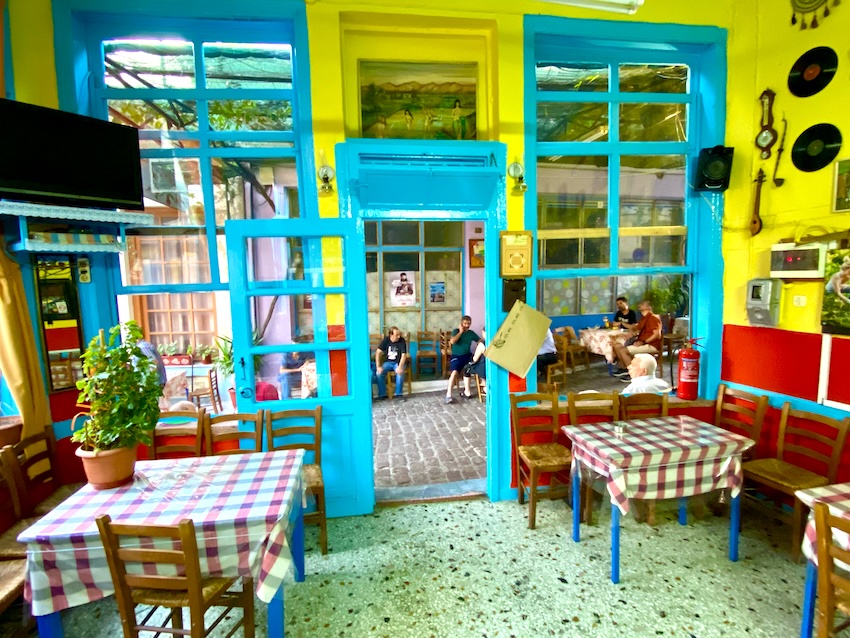
To Exarxaia Kafeneion where I ate my first sardeles pastes. Read more about Agiassos from
my book in
Search of Sardeles Pastes
|
|
Karini
On
the old road to Agiasou from Mytilini there is a
tiny settlement called Karini which should not
be missed. There are a couple cafeneons and a
very nice restaurant next to an amazing spring
that pours from the ground into a large pool
and then is channeled into a fast moving
stream that flows down the mountain to the
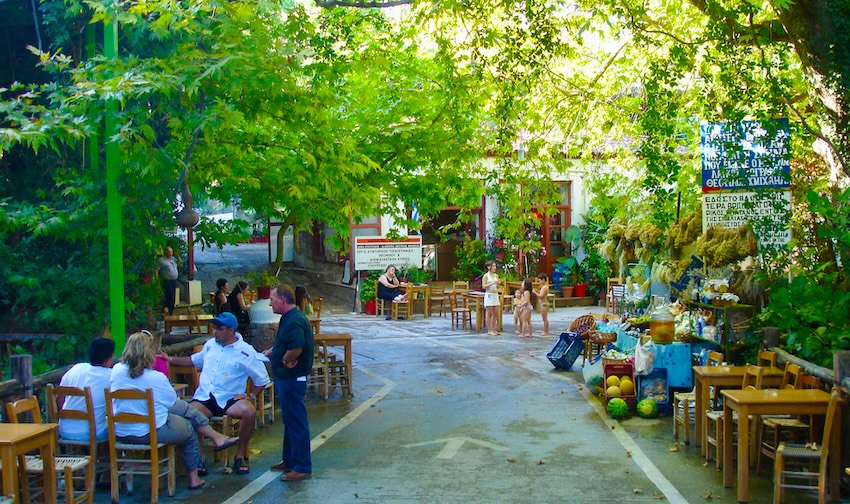
fields and villages below. The area is shaded
and cool, with ducks swimming in the spring
water. You can walk down the steps and cool
your feet in the torrent. On the other side of
the restaurant is a large platanos tree, one
of the biggest on the island. The hollow of
the tree is a room, and I was told is where
the artist Theophilos lived for a time and you can see the remains of one of his murals on the main cafeneon.
If you are
traveling with children this is a great place
to stop and spend an hour or so since the
ducks, stream and tree will keep them
entertained. If you are on the island during
summer and need a break from the heat and have
had your fill of the sea then come up here and
bring a good book. You may discover that it's
better than an air-conditioned hotel
room. (OK maybe not) Because the new road bipasses Karini business has fallen but it really is worth going out of your way for so look for the signs to it.
|