Village Life in Lesvos
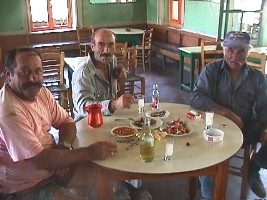 Perhaps the least
known and most charming aspect of Lesvos is life
in the traditional mountain villages. While most
travelers stick to the beaches and seaports, life
in the villages goes on as it has for hundreds of
years, though now modern conveniences like
electricity, television and motorized
transportation have made it a bit easier. In a
typical village, life revolves around the main
square and the cafeneons around it. The men work
in the fields or whatever crafts they have been
trained in. But no matter how hard they work they
always find time to go to the cafeneons. For the
men of the village it is their home away from
home. Or perhaps their homes are their home away
from
home
Perhaps the least
known and most charming aspect of Lesvos is life
in the traditional mountain villages. While most
travelers stick to the beaches and seaports, life
in the villages goes on as it has for hundreds of
years, though now modern conveniences like
electricity, television and motorized
transportation have made it a bit easier. In a
typical village, life revolves around the main
square and the cafeneons around it. The men work
in the fields or whatever crafts they have been
trained in. But no matter how hard they work they
always find time to go to the cafeneons. For the
men of the village it is their home away from
home. Or perhaps their homes are their home away
from
home
|
|
 There are carpenters who build doors and window
frames and whatever else is needed. There are guys
who build roofs or stone walls and pavement. There
is a barber who will shave you using a straight
razor and plenty of hot lather. There is usually a
dry good store that sells anything from beans to
canned foods, soap, and whatever is grown locally
and can be stored. There are butchers who not only
carve up the meat but actually slaughter it in the
shop. If a villager decides it is time to eat one
of his sheep, either for a special occasion or
just to have the meat, the animal is lead to the
butcher shop and using techniques that have been
passed down from father to son, first hypnotizes,
then kills, skins and cleans the animal in about
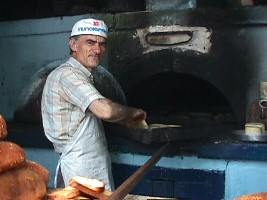
15 minutes. Every village has a bakery and some
may have more than one. The old ovens burn wood,
usually scrap or olive. The bread they make is
usually very
healthy.
There are carpenters who build doors and window
frames and whatever else is needed. There are guys
who build roofs or stone walls and pavement. There
is a barber who will shave you using a straight
razor and plenty of hot lather. There is usually a
dry good store that sells anything from beans to
canned foods, soap, and whatever is grown locally
and can be stored. There are butchers who not only
carve up the meat but actually slaughter it in the
shop. If a villager decides it is time to eat one
of his sheep, either for a special occasion or
just to have the meat, the animal is lead to the
butcher shop and using techniques that have been
passed down from father to son, first hypnotizes,
then kills, skins and cleans the animal in about
15 minutes. Every village has a bakery and some
may have more than one. The old ovens burn wood,
usually scrap or olive. The bread they make is
usually very
healthy.
|
|
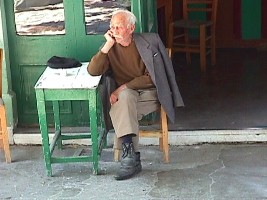 A majority of the people in the villages are old.
Most of the young leave after highschool to work
in Mytilini, Athens or overseas. Many of the old
people have lived in America or Australia and come
back to their ancestral home to retire. Some of
the old people never left and continue to work the
fields and orchards their parents and grandparents
worked. Many villages have olive trees and in
October-November when the olives are ripe all
activity is focused on the collecting and picking.
Many villages have an olive-oil cooperative. The
olives are pressed locally or in a nearby village
that has a facility and the profits are
shared.
A majority of the people in the villages are old.
Most of the young leave after highschool to work
in Mytilini, Athens or overseas. Many of the old
people have lived in America or Australia and come
back to their ancestral home to retire. Some of
the old people never left and continue to work the
fields and orchards their parents and grandparents
worked. Many villages have olive trees and in
October-November when the olives are ripe all
activity is focused on the collecting and picking.
Many villages have an olive-oil cooperative. The
olives are pressed locally or in a nearby village
that has a facility and the profits are
shared.
Cheese is usually home made since many people
have sheep and goats. The process of cheese-making
is virtually un-changed from ancient times. The
milk is cooked outdoors in a big cauldren. Some
villages have their own cheese factories where
farmers can sell or trade their milk. Other
villages have wallnut trees and you will know when
they are in season because everyone's hands will
be dyed black from picking them. In many villages
a man's wealth is measured by how many sheep he
owns.
|
|
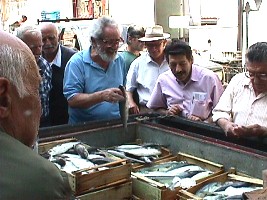 Products like shoes, tables, chairs, socks,
clothes. houseplants, carpets and almost anything
you can imagine are sold out of trucks that make
their way through the villages. Some of these
mobile stores are owned by gypsies who not only
travel from village to village but from island to
island too. Fresh fish is sold out of trucks that
load up from the fishing boats of Molyvos, Skala
Kaloni and the other fishing ports of the island,
and then drive through all the villages announcing
what they have through a loudspeaker. They will
stop in the platia and a crowd will gather, most
to look on and a few to
buy.There are
trucks that come through town calling for people
to bring out their old clothes and furniture and
others that repair pots and
pans.
Products like shoes, tables, chairs, socks,
clothes. houseplants, carpets and almost anything
you can imagine are sold out of trucks that make
their way through the villages. Some of these
mobile stores are owned by gypsies who not only
travel from village to village but from island to
island too. Fresh fish is sold out of trucks that
load up from the fishing boats of Molyvos, Skala
Kaloni and the other fishing ports of the island,
and then drive through all the villages announcing
what they have through a loudspeaker. They will
stop in the platia and a crowd will gather, most
to look on and a few to
buy.There are
trucks that come through town calling for people
to bring out their old clothes and furniture and
others that repair pots and
pans.
|
|
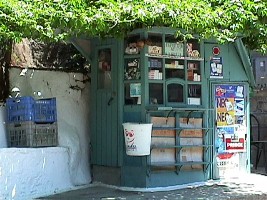 There is usually a 'periptero' where you can buy
cigarettes, gum, envelopes, matches,
newspapers(sometimes), and many other daily
'necesities'. If it is not a free standing
building then there will be a store which serves
the same purpose, usually near the main platia.
Many of the village platias are centered around a
giant 'platanos' or plane tree. Sometimes
important announcements are posted on these trees
and in some villages the inside of the tree is
actually hollow and used for storage. Some of
these trees have provided cool shade in the hot
summer months for hundreds of years. In some
villages farmers will exhibit and sell their
produce in the
platia.
There is usually a 'periptero' where you can buy
cigarettes, gum, envelopes, matches,
newspapers(sometimes), and many other daily
'necesities'. If it is not a free standing
building then there will be a store which serves
the same purpose, usually near the main platia.
Many of the village platias are centered around a
giant 'platanos' or plane tree. Sometimes
important announcements are posted on these trees
and in some villages the inside of the tree is
actually hollow and used for storage. Some of
these trees have provided cool shade in the hot
summer months for hundreds of years. In some
villages farmers will exhibit and sell their
produce in the
platia.
|
|
 The village life for the older men and some of the
younger men too revolves around the cafeneons. The
old men come and go appearing at different
cafeneons
in various formations
all day long. There are just under four-hundred
inhabitants in the village of Xidera, perhaps a
third of them men. There are seven
cafeneons
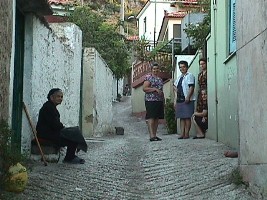
. The women generally don't go to the cafeneons
unless they happen to own it. They stay within the
walls of their homes and gardens or work in the
fields until sunset when they come out to sit in
groups on the street and talk with one
another.
The village life for the older men and some of the
younger men too revolves around the cafeneons. The
old men come and go appearing at different
cafeneons
in various formations
all day long. There are just under four-hundred
inhabitants in the village of Xidera, perhaps a
third of them men. There are seven
cafeneons
. The women generally don't go to the cafeneons
unless they happen to own it. They stay within the
walls of their homes and gardens or work in the
fields until sunset when they come out to sit in
groups on the street and talk with one
another.
|
|
 The cafeneons can be lively with conversation.
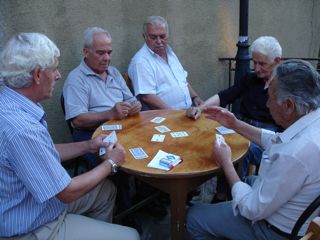
Card games usually draw a crowd. I can't walk into
a cafeneon without someone buying me an ouzo and
asking me about life in America. Many of the old
men you see speak English but they will not let
you know unless you ask them directly. I don't
know if they feel rusty or shy because they have
not used the language in so long but there are
always one or two surprises waiting to happen in
any room full of old men. Some of them have spent
their lives in America and have returned to their
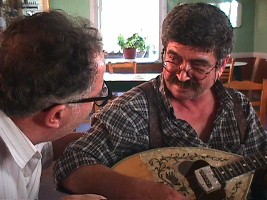
ancestral home to retire. On a Sunday or even
during the week you may find the village musicians
in the cafeneons. The longer they play the more
fun it gets as the more people join in, some
singing along and others
dancing.
The cafeneons can be lively with conversation.
Card games usually draw a crowd. I can't walk into
a cafeneon without someone buying me an ouzo and
asking me about life in America. Many of the old
men you see speak English but they will not let
you know unless you ask them directly. I don't
know if they feel rusty or shy because they have
not used the language in so long but there are
always one or two surprises waiting to happen in
any room full of old men. Some of them have spent
their lives in America and have returned to their
ancestral home to retire. On a Sunday or even
during the week you may find the village musicians
in the cafeneons. The longer they play the more
fun it gets as the more people join in, some
singing along and others
dancing.
|
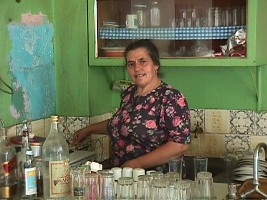 Some of the cafeneons are run by women who are
almost like den-mothers to the men. There are few
if any restaurants in the villages. Food is served
at the cafeneons and the owners are almost always
excellent cooks. They usually serve one special a
day and then basic foods that they always have on
hand like fried potatoes, salads, feta and
whatever fish they have bought off the trucks.
Many times when I see Tryphonos at his cafe for my
breakfast or coffee I will ask him to buy some
makeral, gopes, sardines or another variety of
fish if a truck comes around and they look fresh.
Then at night we have a feast. Sometimes he will
phone the house and tell me that a truck is in
town with a certain type of fish and he asks me if
he should buy it for us for dinner. For breakfast
you can always get eggs, fresh bread and cheese
and of course excellent Greek coffee. A meal in a
village cafeneon will generally cost a fraction of
what a meal in a restaurant will cost. There are
no menus. You have to ask what they
have.
Some of the cafeneons are run by women who are
almost like den-mothers to the men. There are few
if any restaurants in the villages. Food is served
at the cafeneons and the owners are almost always
excellent cooks. They usually serve one special a
day and then basic foods that they always have on
hand like fried potatoes, salads, feta and
whatever fish they have bought off the trucks.
Many times when I see Tryphonos at his cafe for my
breakfast or coffee I will ask him to buy some
makeral, gopes, sardines or another variety of
fish if a truck comes around and they look fresh.
Then at night we have a feast. Sometimes he will
phone the house and tell me that a truck is in
town with a certain type of fish and he asks me if
he should buy it for us for dinner. For breakfast
you can always get eggs, fresh bread and cheese
and of course excellent Greek coffee. A meal in a
village cafeneon will generally cost a fraction of
what a meal in a restaurant will cost. There are
no menus. You have to ask what they
have.
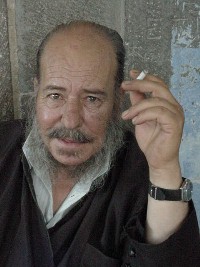 Most cafeneons have a television in the corner and
if there is nothing else to do people may be
sitting around watching a movie though in some
villages, reception is limited because of
interference by the mountans. Though TV seems to
have filled in the gaps between conversation, it
has by no means dominated life in the cafeneons.
Unless there is something important going on like
elections or a big basketball game the television
is treated like a fellow patron who talks a lot
but nobody pays that much attention to unless he
says something interesting. Then they will discuss
it amongst themselves and forget the TV is there.
There is almost always a village priest who you
will see walking to and from wherever it is that
priests go. Many times they can be found in the
cafeneons with the boys or even watching a soccer
match. Though they can look quite severe, with
long beards and dressed in black robes, they are
actually very approachable and it is not a sin to
offer to buy one a drink while you are conversing
in the cafeneons. Regardless of whether they
accept or order a coffee instead, they will be
happy to speak with you about village life, both
material and spiritual.
Most cafeneons have a television in the corner and
if there is nothing else to do people may be
sitting around watching a movie though in some
villages, reception is limited because of
interference by the mountans. Though TV seems to
have filled in the gaps between conversation, it
has by no means dominated life in the cafeneons.
Unless there is something important going on like
elections or a big basketball game the television
is treated like a fellow patron who talks a lot
but nobody pays that much attention to unless he
says something interesting. Then they will discuss
it amongst themselves and forget the TV is there.
There is almost always a village priest who you
will see walking to and from wherever it is that
priests go. Many times they can be found in the
cafeneons with the boys or even watching a soccer
match. Though they can look quite severe, with
long beards and dressed in black robes, they are
actually very approachable and it is not a sin to
offer to buy one a drink while you are conversing
in the cafeneons. Regardless of whether they
accept or order a coffee instead, they will be
happy to speak with you about village life, both
material and spiritual.
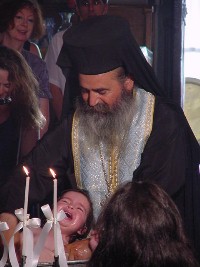 There is always more than one church in or around
the village and the popular Saint day of a
particular church is celebrated at a Panayiri with
services and a celebration with food wine and
dancing. The August 15th celebration of the Virgin
Mary is the biggest. There are musicians, roasting
of lambs and dancing that goes on until dawn. At
other times during the year people will visit
neighboring villages on their particular saint's
day. The priest also administers events like
baptisms, funerals and everything in between.
Usually the entire village turns out for the
service and then goes to the reception in the
cafeneons. For very special events a high ranking
priest will come from a larger town or from
Mytilini. Many of the churches in the village are
quite old and impressive, containing icons and
wall paintings that are historical and
valuable.
There is always more than one church in or around
the village and the popular Saint day of a
particular church is celebrated at a Panayiri with
services and a celebration with food wine and
dancing. The August 15th celebration of the Virgin
Mary is the biggest. There are musicians, roasting
of lambs and dancing that goes on until dawn. At
other times during the year people will visit
neighboring villages on their particular saint's
day. The priest also administers events like
baptisms, funerals and everything in between.
Usually the entire village turns out for the
service and then goes to the reception in the
cafeneons. For very special events a high ranking
priest will come from a larger town or from
Mytilini. Many of the churches in the village are
quite old and impressive, containing icons and
wall paintings that are historical and
valuable.
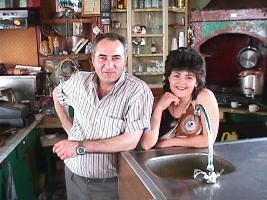 Very few villages have hotels but usually there is
a guesthouse of some sort for the few 'strangers'
who come or people who come to work in the village
for short periods. In the summer the villages are
full of activity. People return from Athens or
abroad and the streets are filled with children.
The cafes are full of men and women who sit
outside and enjoy the cool evening air which is
alive with music and conversation. Inside the cafe
owner is kept busy but this is the period when
they make most of their money so they really don't
mind and during the summer there are always family
members around to help. The temperature is
generally much more pleasant in the mountains of
Lesvos then it is on the plains or the coast.
Anyway there is no village that is more then
twenty minutes away from the nearest
beach.
Very few villages have hotels but usually there is
a guesthouse of some sort for the few 'strangers'
who come or people who come to work in the village
for short periods. In the summer the villages are
full of activity. People return from Athens or
abroad and the streets are filled with children.
The cafes are full of men and women who sit
outside and enjoy the cool evening air which is
alive with music and conversation. Inside the cafe
owner is kept busy but this is the period when
they make most of their money so they really don't
mind and during the summer there are always family
members around to help. The temperature is
generally much more pleasant in the mountains of
Lesvos then it is on the plains or the coast.
Anyway there is no village that is more then
twenty minutes away from the nearest
beach.
|
|
|
|
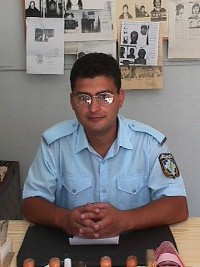
Not
every village has a policeman.
Savas is stationed in Antissa but
fights crime as far away as
Skalahori. Some villages like Xidera
have not had a policeman in
several hundred years and are
considered 'wild' by other
villages. |
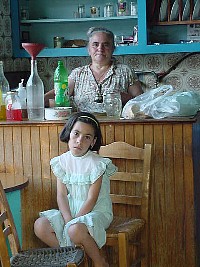
Aglaia
runs a cafeneon in Xidera with her
husband Panayotis, the village
butcher. She is an amazing cook
and also acts a host-mother for
all the young and old men who
drift in and out of the cafe each
day. |
|
|
|
|
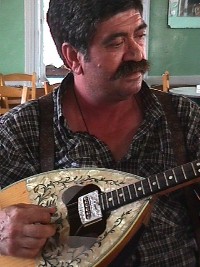
Bobis
is well known for being a talented
bouzouki musician who can play
hundreds of old rembetika songs,
and he is the artist who paints
most of the signs for the
restaurants and cafes in western
Lesvos. He is also the mailman in
Antissa.(Now retired) |
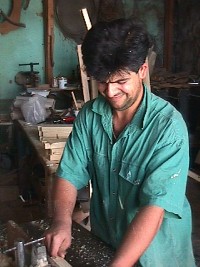
Michalis
is a carpenter with his own
woodshop that he works at with his
father. He has a cafeneon too,
right across the street. Many
people in the village do more than
one job to make ends meet. They
also supplement their income
through agriculture. |
|
|
|
|
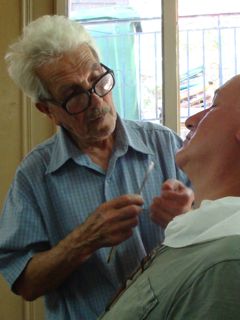
Without
a doubt Yannis from Vatousa is the
most famous barber in Lesvos. His
photo was featured in an article
in Islands Magazine by Patricia
Storace. He uses a straight razor
and will probably give you the
best shave you have ever
gotten. |
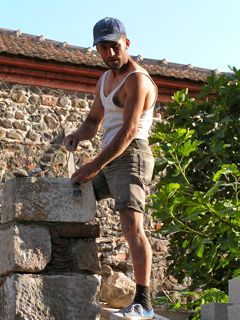
Spiro
Kupe is a talented stone mason,
a Greek from Albania who lives in
Vatousa. He hopes to go to America
to work and teach. All the houses
in the villages are made of stone.
If you want to build a stone house
anywhere go to Vatousa and hire
him. |
|
|
|
|
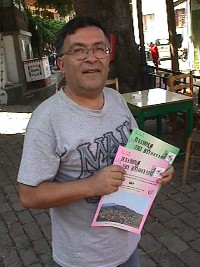
Yannis
Manouchos publishes the
Pulse
of
Vatousa
, a monthly magazine for all the
people connected with the village,
whether they live on the island or
abroad. |
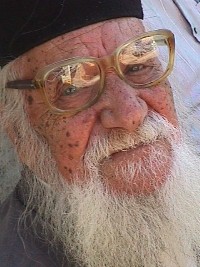
The
old priest in Vatousa was one of
my favorite people. He asked me to
send him some Ben-gay from the
states for his arthritis. The next
summer he was very pleased to see
me. He died the following
year. |
|
|
|
|
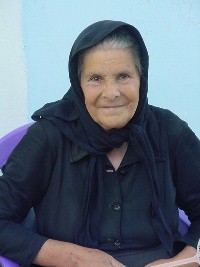
The
villages are primarily filled with
old people and most of them are in
pretty good shape. They have to
be. The streets are steep and the
winters are cold and the work
never ends. |
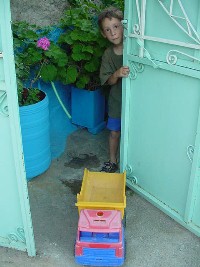
Still
there are plenty of children in
the village, especially during the
summer when they come to visit
their grandparents or in Xidira which has not seen a mass exodus to Athens. |
|
|
|
|
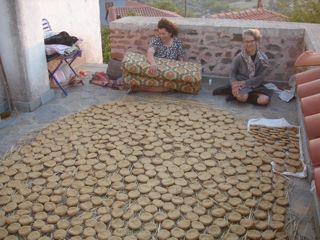
In the summer the villagers make trachana from wheat and goats milk to use as a winter staple. They dry it in flat areas and they have to stand guard 24 hours a day for three days to keep the cats from eating them.
|
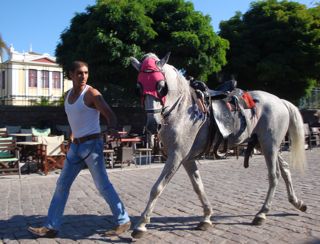
The most popular sport in the village is horse-racing which in the villages of Lesvos has more in common with American drag racing than it does with the Kentucky Derby. There is a big race in Agia Paraskevis in early July. |
|
|
|
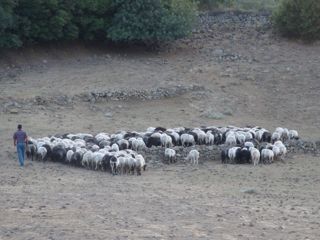
| It is hard to say whether the main occupation of most village men is tending sheep... |
... or playing cards |
|
|
|
|
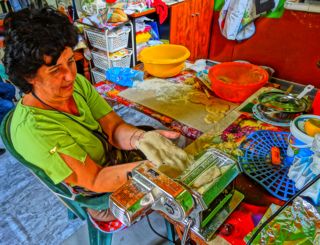
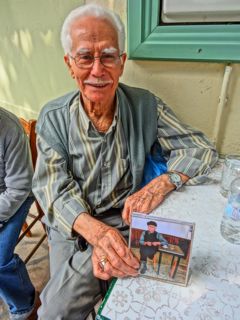
Poppy and her family make traditional sweets in their small workshop and sell them in the family grocery store in the Vatousa main square right by the cathedral. Their rice pudding alone is worth the trip as is a visit to the workshop to see what they are making that day.
|
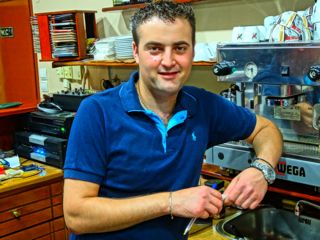
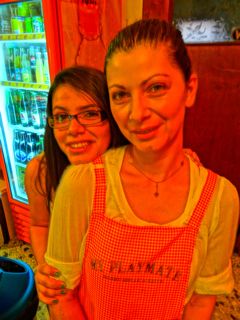
If anyone was born to be a restaurateur it is Giorgos who has been waiting tables in his parents restaurant in Vatousa since he was 5. He now runs Rena's, the cafeneon-psistaria in Vatousa on the road through the lower village. His father and mother do the cooking.
|
|
|
|
|
Mitso had a long career selling cassettes and CDs in Omonia Square in Athens. He now sells his own CDs in the square of Vatousa. What makes this interesting is that he plays all the instruments. What makes this more interesting is the only instrument is his mouth.
|
There is no cafeneon owner more lovely than Vasso and no staff more beautiful than her daughters. Maybe that is why her zacharoplasteion (sweet shop) became so popular with the young men that she expanded and became the third cafeneon in Vatousa's village square.
|
|
|
|
|
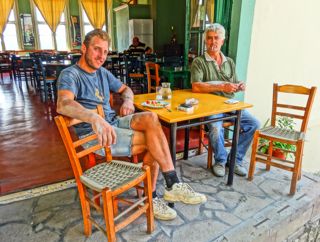
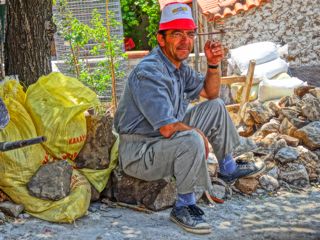
Stone masons, carpenters, painters and workers who know how to build and fix houses in the traditional style, like Thomas and Panayotis are in demand in Vatousa.
|
Mitso has been building stone walls and houses since he was a boy and many of the young men who worked for him went off to start their own contracting companies, like Spiro Kupe.
|
|
|
|
|
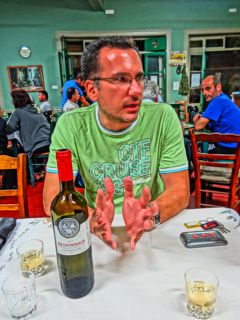
Like almost everywhere in Greece the crisis has brought on a back-to-the-village movement, led by pioneers like Yiannis Lambrou who traded academia and philosophy for the Methymnaos Winery in Xidira
|
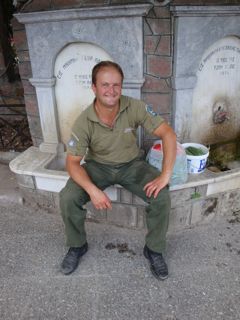
Michalis is a former restaurant owner who changed careers and is now a member of the forest service which is like being a policeman who protects the mountains, valleys, rivers and forests of Lesvos.
|
|
|
|
|
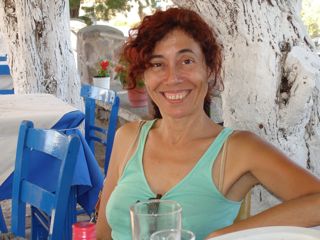
Pamela Jerome is a well known NYC architect and the world's foremost expert on mud-brick architecture, who makes her home in the village of Vatousa where she restores houses and provides advice to foreigners who want to build or restore houses in Lesvos.
|
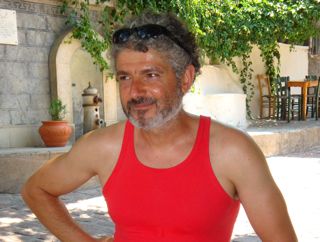
Christos has worked as a waiter in Santorini and had his own bar in the village of Sigri. But he chose the simple life in the village of Vatousa where he tends his flock of sheep and works in his garden. In the winter there is not much to do so he watches a lot of American movies.
|
Thanks to the people of the villages of Vatousa and Xidira in Lesvos. If you want to contact any of these people e-mail matt@greecetravel.com
|
|
39 Coffeee Houses and a Barber’s Shop
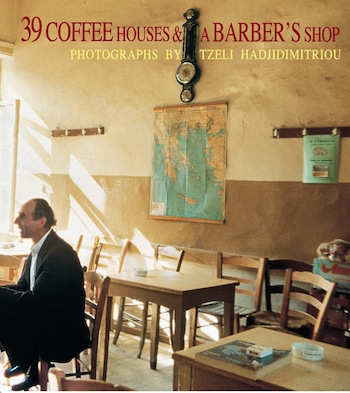 Photographic album. Texts: A. Fasianos, F. Frangouli, G Chronas, E. Papataxiarchis, G. Nikolakakis, Th. Paraskevaidis. Paper back edition, 144 pages. 1st edition 1997 by Crete University Press. price 25 euro Photographic album. Texts: A. Fasianos, F. Frangouli, G Chronas, E. Papataxiarchis, G. Nikolakakis, Th. Paraskevaidis. Paper back edition, 144 pages. 1st edition 1997 by Crete University Press. price 25 euro
“In the pictures of Lesvos’s coffee-houses, Tzeli strikes the right balance between light and color. Allthough the pictures are filled with details, none of them jump out to distract one’s gaze but instead are orchestrated to create an atmosphere both soothing and highly vivid. Tzeli is indeed deft at turning the seemingly banal into stories about the passage of time and the endurance of human values. So while coffee-houses are a subject largely exhausted by
a folkloric,
pseudo-sentimental aesthetic, Tzeli puts them back into the right perspective. Despite her emotional ties with the island-she was born there-she does not retreat into nostalgia. Instead, she offers a vision that is tender, meditative and thoroughly dignified. What motivates her is a desire to give visual expression to moods and to evoke fading habits and lifestyles. ”
Click Here for Ordering Information
|
|