|
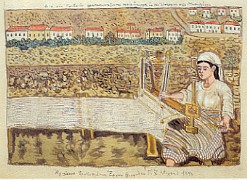 More often
he would wear a kilt and carry an old curved
yataghan at his side or he would paint murals of
the Greek War of Independence. It was thus he
appeased his passion.
More often
he would wear a kilt and carry an old curved
yataghan at his side or he would paint murals of
the Greek War of Independence. It was thus he
appeased his passion.
He left for Pelion on the mainland where he found
work as a shepherd, and there, whenever he came
across a mill or a coffeehouse with plastered
walls, he would cover them with murals. He wore
his kilts all the time there, even though the
local people wore breeches and thus he earned
himself the nickname Tsolias. On his return from
Volos he threw away his shepherds crook and earned
himself a living any way he could, begging for a
piece of canvas or a white wall where he could
paint his pictures. He didn't ask for money; only
a plate of food and a supply of water-colors. His
passion was to paint heroic themes, events in the
life of Ali Pasha, and hunting scenes. When he was
dead the critics of Athens and Paris proclaimed
him a great painter and his pictures became
extremely valuable".
From the book
Vasilis Arvanitis by Stratis Myrivilis written
in 1934.
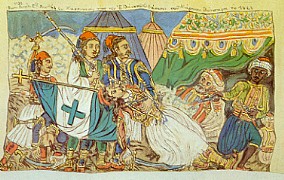 No other folk painter or even perhaps
classical painter has been honored since his
death as much as the day-dreamer Theophilos.
Among the other figures of Greek art and
intellect who were at the August 1965 opening
of his museum was the Nobel prize-winning poet
George Seferis.
No other folk painter or even perhaps
classical painter has been honored since his
death as much as the day-dreamer Theophilos.
Among the other figures of Greek art and
intellect who were at the August 1965 opening
of his museum was the Nobel prize-winning poet
George Seferis.
Be sure to visit the Theophilos Museum in
Mytilini. Don't forget to see the hollowed out
tree Theophilos lived in at the spring of
Karini on the road to Agiassos. Keep your eyes
open and you may discover a Theophilos on the
wall of some cafeneon in a remote village
somewhere on Lesvos. |

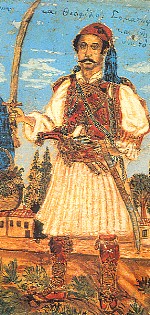 Theophilos
Chatzimichael was born in 1873 at Vareia near
Mytilini town. He died in 1934 from food
poisoning. His works are inspired by history,
mythology, nature and life. They are distinguished
by their primitiveness but also for their
expressiveness and their color combinations. The
paintings of Theophilos are difficult to find
today and their value has reached astronomical
heights. Large art foundations in Europe and
America have opened their salons to his works
which have been insured by Lloyd's of London for
enormous amounts.
Theophilos
Chatzimichael was born in 1873 at Vareia near
Mytilini town. He died in 1934 from food
poisoning. His works are inspired by history,
mythology, nature and life. They are distinguished
by their primitiveness but also for their
expressiveness and their color combinations. The
paintings of Theophilos are difficult to find
today and their value has reached astronomical
heights. Large art foundations in Europe and
America have opened their salons to his works
which have been insured by Lloyd's of London for
enormous amounts.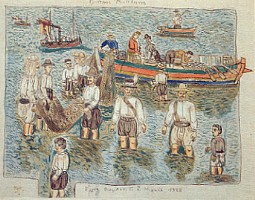 "He was a
strange man and people thought him half crazy. He
wasted away poor and alone in his unwashed kilts.
You might wonder how an islander came to be
wearing kilts. Well it was his passion. He used to
long for the annual carnival so he could wear his
kilts out of doors. Sometimes he would dress up as
a Macedonian, sometimes as a soldier of the Greek
kilted regiment. He was a short, pale sickly man
but nevertheless there burned within him a
passionate desire for the heroic stature which God
had denied him. Sometimes at carnival he would
gather his friends together and they would all
dress up as Olympic gods. Theophilos would always
be Ares, the god of war. He would wear a crown of
gold-colored cardboard and carry a wooden spear
with it's point covered in silver paper and a
round shield made of a thin board. On the shield
would be painted the head of Medusa with her snake
hair. Because he suffered from alopecia the hairs
of his mustache were sparse and he would wear a
false moustache made of tow, which he would twist
fiercely as he walked behind the red mantle of
Zeus.
"He was a
strange man and people thought him half crazy. He
wasted away poor and alone in his unwashed kilts.
You might wonder how an islander came to be
wearing kilts. Well it was his passion. He used to
long for the annual carnival so he could wear his
kilts out of doors. Sometimes he would dress up as
a Macedonian, sometimes as a soldier of the Greek
kilted regiment. He was a short, pale sickly man
but nevertheless there burned within him a
passionate desire for the heroic stature which God
had denied him. Sometimes at carnival he would
gather his friends together and they would all
dress up as Olympic gods. Theophilos would always
be Ares, the god of war. He would wear a crown of
gold-colored cardboard and carry a wooden spear
with it's point covered in silver paper and a
round shield made of a thin board. On the shield
would be painted the head of Medusa with her snake
hair. Because he suffered from alopecia the hairs
of his mustache were sparse and he would wear a
false moustache made of tow, which he would twist
fiercely as he walked behind the red mantle of
Zeus.